
AI news ·
Rochester's Warner School faculty offer research-based guidance on using AI to support teachers in K-12 classrooms
61% of K-12 teachers now use AI tools in class, nearly double the share from two years ago. Researchers identify five practical uses-from adapting materials to reflecting on lessons-that support teachers without replacing them.
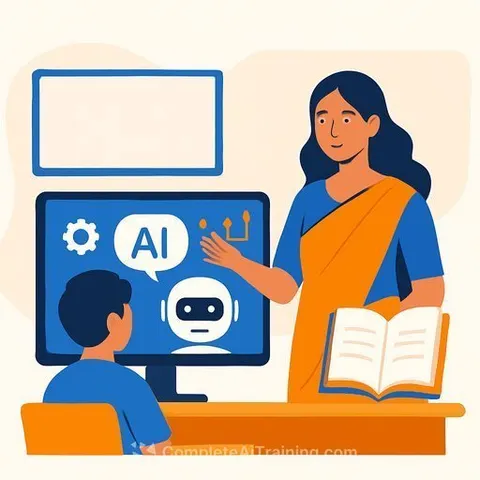
Teachers are using AI to teach better, not to teach less
Sixty-one percent of K-12 teachers now use AI tools in their classrooms, nearly double the share from two years ago. The question has shifted from whether teachers will adopt these tools to how they use them effectively.
Fred Young, a secondary math and computer science teacher in upstate New York, uses ChatGPT to brainstorm lesson ideas. He uploads activities he's already taught, asks for new ways to engage students, reviews the suggestions, and adapts the strongest ones. The process saves time without removing his judgment from the work.
"It's a huge time saver," Young said. "I'll get five or six options back, pick what makes sense, and modify it for my class."
Educators at the University of Rochester's Warner School of Education and Human Development have spent the past two years studying how teachers actually use AI. Their research points to five concrete applications that strengthen instruction without replacing teachers.
Make content accessible to more students
AI tools can adapt materials quickly for students with different reading levels, language backgrounds, or learning needs. A tool like Diffit lets teachers generate multiple versions of the same text-adjusted for reading level, with vocabulary supports, translated into other languages, or paired with guided questions-while keeping all students focused on the same core concepts.
This shifts teacher work from rewriting materials to supporting student understanding. Kristen Love, an associate professor at the Warner School, said: "Learning happens when students are supported just beyond their current level of understanding. AI helps teachers provide that support more efficiently, so students can engage with meaningful content rather than be shut out by it."
Connect lessons to student interests
Students ask a predictable question: when will I ever use this? Research shows students are more motivated when they see real value in what they're learning. AI makes it easier to rewrite a math problem around sneaker design, create a story where students are the main characters, or connect a science concept to a community issue.
In Young's algebra classes, students conduct hands-on experiments exploring relationships between variables, then compare their results with AI-generated responses and discuss the differences.
Design assignments that show what students actually know
Traditional tests don't capture every student's understanding. AI can help teachers design podcasts, videos, or hands-on projects that let students demonstrate learning in varied ways. Young's computer science students build a simple rock-paper-scissors app using a Markov matrix-a mathematical model that predicts outcomes based on probabilities-to learn how AI works.
Love said: "AI should never replace student thinking. Instead, it should expand how students demonstrate their learning."
Communicate with families more consistently
Teachers spend significant time drafting newsletters and emails home. AI tools like Google NotebookLM and Magic School can draft classroom communications, translate messages into families' home languages, and simplify complex information in minutes.
A teacher can prompt the tool: "Turn these notes into a family-friendly weekly update" or "Rewrite this email in a more welcoming tone." Paired with design tools, teachers can create visually clear communications without added workload. Research shows families who are informed and involved are more likely to support student success.
Reflect on teaching to improve it
AI-supported reflection helps teachers improve faster. Tools like Colleague AI analyze lesson plans to predict where students might struggle or suggest better questions. Video tools like Vosaic let teachers record lessons, tag specific moments-wait time, types of questions, student participation-and review patterns with an AI coach.
Cynthia Carson, an assistant professor at the Warner School, said: "AI can serve as a thought partner, helping teachers analyze their lessons and identify opportunities for improvement."
Keep humans in charge
Young is deliberate about how his students use AI. He tells them it's not a shortcut but a tool-like a measuring tape that helps you get the answer but doesn't do the measuring for you.
"I'll tell my students: if you're stuck, you can ask AI tools for help, but then read the response, check it, and make sure you understand it," Young said.
For newer teachers, AI can reduce workload while building confidence. Young's advice: "Use what you know about teaching and your students-and let AI make your life easier. But you still have to bring your expertise to it."
AI cannot replace the relationships, judgment, and human connection that effective teaching requires. The opportunity for educators is to learn how to use these tools well enough that they spend less time on administrative work and more time supporting students.
The Warner School offers an online Advanced Certificate in Artificial Intelligence for Educators designed to help teachers build practical skills for using AI thoughtfully and responsibly in classrooms. For more resources on this topic, explore AI for Education or consider the AI Learning Path for Teachers.