
AI news ·
Sales AI falls short when teams automate tasks instead of redesigning decisions, Gartner says
61% of chief sales officers report no meaningful quota improvement from AI sales initiatives. The core problem: most teams used AI to speed up tasks instead of redesigning the decisions that actually drive results.
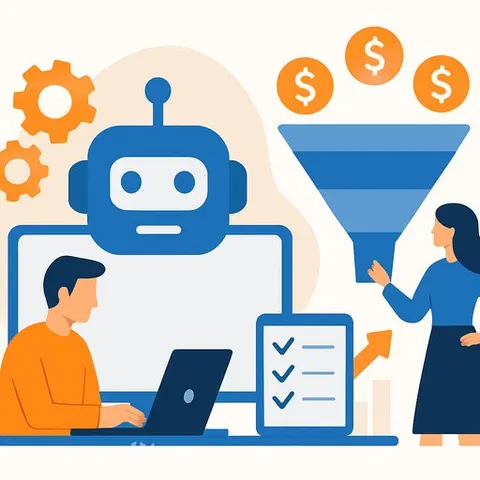
Why Most Sales AI Fails to Improve Results
Thirty-nine percent of chief sales officers say AI-focused sales initiatives have increased the percentage of sellers who meet or exceed quotas. That means 61% see no meaningful improvement.
The problem is not that AI cannot help sales. Most organizations used it to optimize tasks when they needed to redesign decisions.
Sales teams now have copilots, summaries, prompts, and workflow add-ons. Reps update CRM fields faster. Managers run forecast meetings more quickly. But selling itself has not fundamentally improved. Faster activity without better judgment rarely changes performance.
Task Assistance vs. Decision Engines
AI is typically deployed as a task assistant. It helps complete work faster but does not improve the moments that actually determine results.
Consider a deal that has aged beyond benchmark, lacks executive engagement, and has no confirmed mutual action plan. In a task-first model, AI summarizes the risk and the manager asks for an update. In a decision-first model, those signals trigger a commit review. The manager must validate the commit, move the deal out, or define the action required to keep it in.
The difference is not the insight. The difference is the decision the insight forces.
A decision-first workflow replaces status-heavy discussions with clear gates. AI surfaces signals such as stage age versus benchmark or whether a mutual action plan exists. People then apply context and judgment around strategic importance, competitive credibility, and executive engagement. The goal is a better call made earlier, with fewer surprises later.
Decision Rights Create Speed
A decision-first workflow should answer four questions: What signal does AI surface? What judgment must people apply? Who has the right to decide? What gets audited later?
AI does not create speed. Explicit decision rights do.
Revenue teams need to define who recommends, who decides, when exceptions escalate, and what gets audited later. In forecasting, AI can recommend while managers decide. In pricing, sellers and AI can propose within approved ranges, with escalation triggered only when thresholds are crossed. For next best action, AI can guide the default path while sensitive cases route to oversight.
Many leaders worry that involving AI in decisions creates risk. Ambiguity creates far more risk. When every recommendation requires extended debate or committee review, inconsistency grows and speed collapses. Clear guardrails allow organizations to push execution to the edge while keeping accountability intact.
The Frontline Manager Is the Conversion Point
AI does not change seller behavior directly. Managers do.
The frontline manager is the highest-leverage conversion point between AI insight and commercial performance. Without that translation layer, AI becomes another dashboard: visible, interesting, and mostly disconnected from behavior.
Research shows that managers who use data-driven guidance to identify the highest-impact coaching opportunities are 4.3 times more likely to exceed expected profit growth. Yet only 15% of frontline managers primarily use data to guide the focus of coaching conversations. That gap helps explain why so many AI initiatives stall after rollout.
Managers need three new capabilities:
- Signal literacy: Understanding what matters and why.
- Translation: Connecting data to the reality of the deal, account, or seller.
- Coaching conversion: Turning insight into a focused behavior change that is reinforced over time.
For sales managers looking to develop these skills, an AI Learning Path for Sales Managers can provide structured guidance on translating AI insights into coaching effectiveness.
Design the Default Path Intentionally
The default path is the route work follows when no one intervenes. In an AI-enabled sales organization, that path needs to be designed, not inherited.
Leaders should decide where AI can recommend, where it can act, where sellers can override, where managers must intervene, and where governance must inspect patterns over time. AI can create speed, but people still protect empathy, trust, and complex judgment. That makes operating-model design more important, not less.
Organizations that focus too heavily on adoption often see quality erode. Customer interactions become less thoughtful. Coaching becomes noisier. The better approach is to design the default path intentionally. Clear decision rights accelerate execution. Guardrails protect margin and risk. Governance prevents drift.
A simple discipline helps keep AI grounded in outcomes: inspect weekly and decide monthly.
Start With One Workflow
The move from experimentation to impact should be concrete. Pick one workflow. Redesign one decision gate. Specify what the AI recommends, what people decide, when exceptions escalate, and what gets audited.
Then equip managers to diagnose the signal, explain its importance, coach the action, and reinforce the behavior. That is how AI starts to sell. Not by replacing sellers or automating another task, but by improving the quality and speed of the decisions that matter most.
The teams that win this phase will not be the ones with the most tools or the most AI. They will be the teams that redesign work so AI sharpens judgment, strengthens coaching, and improves the decisions that revenue growth depends on.
For a deeper exploration of AI for Sales, sales professionals can access resources on implementing these decision-first frameworks across their organizations.