
AI news ·
Salesforce data shows AI agent adoption in customer service rises from 39% to 66% in one year
AI agent use in customer service has jumped to 66% of organizations, up from 39% a year ago. But 55% still flag reliability and hallucinations as their biggest barrier to scaling.
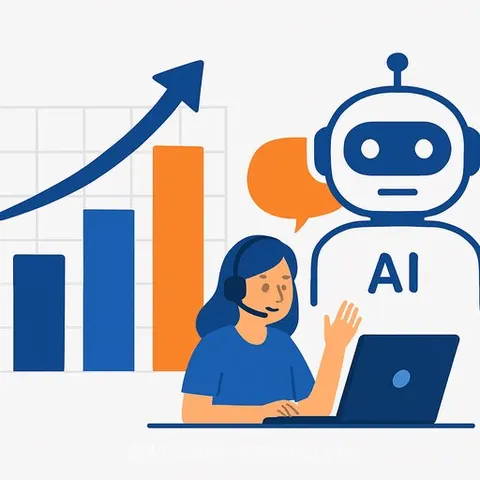
AI Service Agents Move From Pilot to Mainstream - But Reliability Questions Persist
Adoption of AI agents in customer service has jumped to 66% of organizations, up from 39% a year ago, according to Salesforce's latest report. The shift signals the technology has moved beyond experimentation into operational use.
What's changed most: customer satisfaction is now the top metric improving from AI agent deployments, replacing traditional measures like cost savings and agent productivity. Seven in ten organizations deploying AI agents saw measurable value within 60 days.
The findings come from a survey of 3,075 customer service professionals worldwide and represent the first year where the conversation has shifted from potential to results.
Satisfaction Becomes the Competitive Battleground
For years, AI in customer support was sold on efficiency: fewer tickets, faster resolution times, lower headcount. That argument no longer drives decisions.
As two-thirds of service teams now use AI agents, vendors like Microsoft, Google, and Salesforce are competing on customer experience outcomes. Organizations want proof that AI improves how customers feel, not just how quickly tickets close.
This shift puts pressure on vendors to tie AI investments to measurable customer sentiment, not back-office metrics. The winners will demonstrate direct impact on customer outcomes.
Reliability and Hallucination Remain the Blocking Issue
Despite rapid adoption, 55% of organizations still cite reliability and hallucination management as their top challenge with generative AI, according to Futurum Group's 1H 2026 survey of 820 decision makers.
Rapid value realization is easy to celebrate. Scaling AI agents to handle complex, judgment-intensive cases is harder. Most enterprises remain skeptical of black-box AI decisions when customer trust is at stake.
Organizations risk hitting a scaling wall when they move AI agents beyond simple, repetitive inquiries. Until vendors systematically reduce hallucination rates and improve transparency, governance and compliance requirements will cap how much AI can handle.
Measurement frameworks also need to evolve beyond vanity metrics. True business value requires capturing both gains and risk exposure.
Platform Lock-In Threatens Future Flexibility
As AI agents become standard in customer service stacks, enterprises face a critical choice: deeply integrated, vendor-specific solutions or more open, interoperable platforms.
Buyers currently prioritize vendor expertise and implementation speed over theoretical flexibility, according to the Futurum survey. That preference creates execution risk. Organizations may lock themselves into proprietary workflows before interoperability standards mature, making future migrations costly.
The three most important selection criteria for AI platforms are vendor expertise (13.7%), implementation speed (7.7%), and price (5.6%). None of those factors favor openness or portability.
What Matters Next
- Can satisfaction gains hold? Will customer experience improvements persist as AI agents take on more complex cases requiring judgment?
- Will reliability improve enough? Can vendors reduce hallucination rates sufficiently to win trust for regulated workflows by 2027?
- Who dominates? Will Salesforce, Microsoft, or Google win the service AI market, or will standards for interoperability emerge?
- How will value be measured? Organizations need frameworks to separate customer experience gains driven by AI from improvements made by human staff.
For customer support teams evaluating AI agents, the data shows the technology delivers value quickly. The harder question is whether your organization can manage the reliability and governance challenges as you scale beyond initial use cases. Start with AI for Customer Support training to understand how these systems work and their limitations. Then address Generative AI and LLM fundamentals so your team can spot hallucinations and set realistic expectations for what AI can and cannot do in your workflows.