
AI news ·
Small physician practices turn to AI for documentation and administrative tasks as adoption moves beyond experimentation
Small medical practices are adopting AI tools for clinical documentation and phone management, with early results showing measurable time savings. But security concerns and a crowded vendor market are slowing broader rollout.
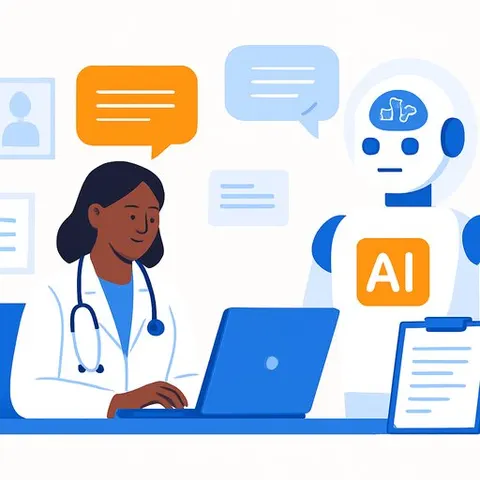
Small Medical Practices Are Moving AI From Experiment to Daily Use
Physician sentiment around AI in healthcare has shifted from skepticism to pragmatism. Fewer doctors now view AI as overhyped, according to athenahealth's 2025 Physician Sentiment Survey, and fewer believe it will complicate care delivery. The focus has narrowed: where does AI actually reduce friction in existing workflows?
Large health systems are already seeing results. UnitedHealthcare launched an AI chatbot for patient navigation. Smaller practices-which lack the scale and resources of major health systems-are moving more slowly but with growing momentum. Many are experimenting with tools like ChatGPT and Claude, but most haven't yet moved beyond testing into routine use.
Clinical Documentation and Administrative Calls Drive Early Adoption
Two areas are showing measurable payoff: clinical documentation and administrative workflows.
AI-based scribing tools listen during patient visits, transcribe conversations, and generate structured notes directly into the EMR. Providers spend less time on paperwork and stay more focused on the patient. The operational benefit is direct: when documentation becomes faster, practices can often see additional patients each day. Even one or two extra patients daily translates into thousands of dollars in additional revenue for a private practice.
That matters in a healthcare economy under pressure. Nearly half of medical group leaders reported declining operating margins year over year, according to the Medical Group Management Association. Modest efficiency gains are no longer nice-to-have-they're survival tools.
AI voice tools are beginning to address the constant pressure on front desk staff. Patient calls to schedule appointments, ask questions, and follow up on care consume significant staff time. AI systems route calls more efficiently, automate routine interactions, and reduce the volume of requests requiring human involvement. Some practices manage higher patient volume without adding headcount; others ease pressure on existing staff.
The Vendor Explosion Creates New Friction
Healthcare AI spending reached approximately $1.4 billion in 2025, nearly tripling year-over-year. That money has fueled a flood of new tools entering the market.
Small and mid-sized practices lack the internal resources to evaluate vendors, assess their long-term viability, or understand how a tool integrates with existing systems. Many practices start their AI evaluation with their EMR vendor-a practical shortcut that simplifies adoption but creates dependency on a single vendor's security posture.
Data security remains the central concern. Nearly 70% of healthcare leaders say data privacy and security issues are a major barrier to AI adoption. That concern is grounded in reality: healthcare experiences the highest cost of data breaches of any industry, according to IBM. The Change Healthcare cyberattack demonstrated how vulnerabilities in third-party systems cascade into operational and financial damage for smaller practices.
Each new AI tool raises questions about patient data handling, storage location, and system integration. For early-stage vendors without a track record in healthcare, those risks are harder to assess.
IT Partners as Strategic Guides
Workforce access to AI tools expanded 50% in just one year, according to Deloitte's State of AI in the Enterprise 2026 report. The pace of change outpaces most practices' ability to evaluate it alone.
Managed Service Providers and Managed Security Service Providers traditionally focused on reactive system maintenance. That role is shifting. Practices now need IT partners who can evaluate AI vendors, understand tradeoffs, identify security concerns, and help prioritize which use cases to pursue first.
Strategic IT support helps practices capture AI's efficiency gains without introducing unnecessary risk. Without that guidance, many practices will struggle to move beyond experimentation.
For small and mid-sized practices, AI for healthcare and AI Agents & Automation offer concrete paths to better margins and expanded capacity-but only with the right evaluation framework in place.