
AI news ·
Three UT San Antonio computer science students gain national recognition for AI homebuilding platform
Three UTSA students rose from 24,000 U.S. applicants to become Red Bull Basement national finalists. Their AI platform Vision aggregates zoning and permit data for homebuilders.
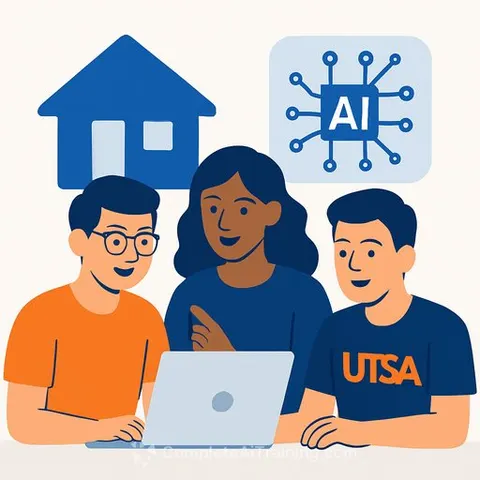
Three computer science students from the University of Texas at San Antonio became U.S. national finalists in the 2026 Red Bull Basement competition with Vision, an AI-based platform that pulls together zoning, permitting, environmental, and infrastructure data so homebuilders can assess site viability before committing time and money. The team rose from a pool of roughly 24,000 U.S. applicants and was one of only two Texas teams to advance.
A family's frustrated homebuilding attempt fuels the idea
The idea for Vision was rooted in Cayden Hutcheson's family experience. They called multiple builders, collected quotes, and hit zoning questions that were not easily answered. The whole plan fell through, leaving behind stress and financial loss. That frustration drove Hutcheson and his teammates Eric Lee and Tri Nguyen - all students in the College of AI, Cyber and Computing - to build a tool that makes the early planning stage more transparent.
"We took that frustration and built around it," Hutcheson said. "The platform pulls together zoning, permitting, environmental and infrastructure data in one place so homebuilders and developers can quickly assess whether a site is viable before committing time and money to it." The project reflects a growing wave of AI for Real Estate & Construction tools that target the industry's data fragmentation.
National finals in Detroit test the pitch
The team entered the Red Bull Basement competition, a global innovation program that supports students building technology-based solutions to real-world problems. After submitting a one-minute video pitch, they landed a spot at the U.S. National Finals in Detroit, where they presented Vision to a panel of judges. Lee said the experience underscored how much storytelling matters when pitching a startup.
"This experience taught me how important communication and storytelling are when pitching a startup idea," Lee said. "Our platform features house generation, cost breakdowns, builder search and a build schedule, which can all be centralized and finished in minutes." Nguyen added that watching other teams pitch sharpened his sense of problem-solving approaches. Developing a startup concept from initial frustration to a polished competition entry illustrates the hands-on demands of AI for Product Development.
Summer internships and campus leadership ahead
Although Vision did not advance to the World Finals, the students are moving into professional roles. Hutcheson, a data science concentration with a math minor, is interning as a systems engineer at MITRE on the Cyber Effects and Information Warfare team. He also runs his own software consultancy, Vorpex LLC, and serves as co-director of RowdyHacks, UT San Antonio's hackathon.
Nguyen is interning at Cooledtured LLC, an online retailer specializing in pop culture collectibles, while Lee will work as a remote software engineer intern at Progressive Insurance. In the fall, Lee returns as president of the Association for Computing Machinery, the largest student tech organization on campus.
Why this matters for IT and product development professionals
Vision tackles a narrow but costly problem in homebuilding: the scattered, slow process of verifying a site's legal and physical constraints. By aggregating permit, environmental, and infrastructure data, the platform cuts decision time and reduces the risk of sunk costs - a model that could extend to other regulated industries. For developers and product managers, the students' path from a concrete pain point to a functional prototype and a national pitch reinforces the value of domain expertise and rapid iteration when building early-stage AI tools.