
AI news ·
Treating AI agents as employees reduces managerial oversight
A 1,200-person study found treating AI as employees drops error detection by 16%. Experts urge HR to assign clear human ownership to stop managers from skipping checks.
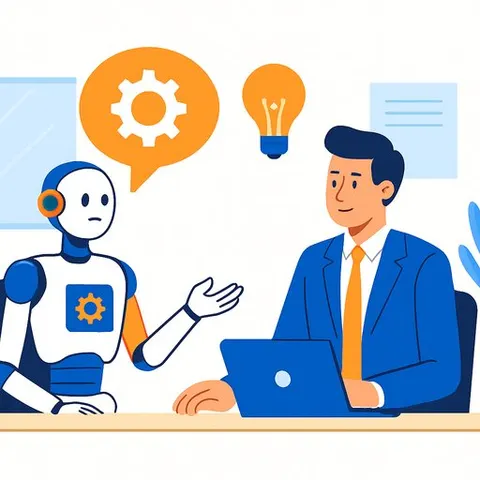
A growing number of companies have stopped treating AI as software and started giving it names, job titles, and a place on the org chart. Research published this July shows that shift carries an unintended cost: when managers see an AI agent as a coworker, they review its work less carefully. The study, led by Boston University professor Emma Wiles and Boston Consulting Group, surveyed 1,200 managers and found that labeling an AI as an employee reduced error detection by 16% among those familiar with org-chart AI.
How the experiment worked
Each participant received five documents with built-in errors and 20 minutes to review them. The only difference across the three groups was the stated author. One group was told they were reviewing work produced by an AI tool. A second group was told the work came from ALEX-3, an AI employee who reported directly to them. The third group was told the author was Alex, a human direct report.
Wiles explains the psychological shift with a comparison. "If you think of AI as a tool, like a spreadsheet, and there's a mistake you make in it, you think, oh man, I made a mistake," she said. "But if you were to start calling your spreadsheet Steve, then at some point you might be convinced that Steve made a mistake, as opposed to you were working with this tool and you made a mistake."
Why the label changes behavior
For most managers, the label made little difference. But among the roughly 23% whose organizations already include AI agents on their org charts, the effect was significant. The AI employee framing led to a 16% drop in error detection compared with the AI tool framing. Only the human employee group received the thorough scrutiny managers normally apply.
"I think that framing them as an employee sort of changes their mode of operation where they're no longer thinking, 'I'm working with a tool,' they're thinking, 'I'm delegating to an employee,'" Wiles said.
When managers draft something themselves using a tool like ChatGPT, they know their name goes on the final product. That sense of personal responsibility drives them to check the work carefully. An AI employee breaks that link. Managers assume the organization wouldn't assign them an unreliable agent, so they skip the level of scrutiny they'd give their own output.
A different kind of buck-passing
The study also found that managers who missed more errors under the AI employee framing were more likely to ask someone else to double-check the work. They didn't necessarily trust the output more-they simply delegated the oversight to another person.
"They're just kind of kicking it down the road," Wiles said. "It's not that they necessarily think it's so good, they're just sort of like, it's already not my job."
The risk compounds as more companies embed AI agents into formal workflows. If everyone assumes the agent's work is someone else's problem, quality can slip across the organization. "I think the risk is that basically everyone says, well, the agent did it, that's not my problem," Wiles said. "And then you could have worse quality work."
What HR can do about it
Wiles does not recommend avoiding AI agents. Instead, she argues that accountability must be defined before ambiguity takes hold. "You want to be extremely clear about where accountability rests with any work being done by an AI agent," she said. "Every agent is owned by a person, and if the agent does something wrong, that person is going to be the one who's held responsible for it."
Deciding who owns an AI agent's work is as much an HR decision as a technical one. As organizations reconfigure org charts and reporting lines to accommodate AI, HR leaders must ensure that every agent has a named human owner who answers for its mistakes. McKinsey's 2025 State of AI survey found that 62% of organizations are already experimenting with AI agents, even though most have not redesigned their workflows or governance structures around them. Capability is outpacing accountability.
HR professionals can find guidance on managing AI responsibly at AI for Human Resources. For those overseeing teams that use AI agents, the AI Learning Path for HR Managers offers practical training on oversight and integration.
Why this matters for HR
The research surfaces a specific, actionable risk: when AI agents sit on the org chart, managers stop checking their work. The fix is not to remove the agents but to assign clear ownership. HR is the function that defines roles, reporting lines, and accountability. Without a deliberate policy, the default behavior will be to pass the buck. The question is no longer whether AI agents can do the work. It's whether anyone is truly responsible when they get it wrong.