
AI news ·
UC San Diego researchers launch AI tool that coaches bystanders through CPR in real time
UC San Diego released ChatCPR, an open-source AI tool that talks bystanders through CPR during cardiac arrests. A JAMA study found it outperformed 911 dispatchers at guiding the procedure.
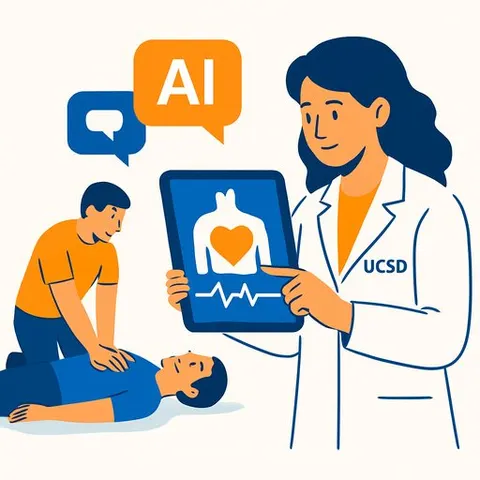
UC San Diego Launches ChatCPR to Coach Bystanders Through Cardiac Arrest
Researchers at UC San Diego have released ChatCPR, an AI tool that guides people through CPR in real time during out-of-hospital cardiac arrests. The open-source system launched this week alongside a study in JAMA showing it outperforms 911 dispatchers at instructing bystanders through the procedure.
The project emerged from frustration with healthcare AI's track record. John Ayers, head of AI at UC San Diego's Altman Clinical and Translational Research Institute, said most AI applications in medicine remain theoretical. "It's all hype, no reality," he said of the current state of healthcare AI deployment.
The Problem: Speed Matters in Cardiac Arrest
More than 350,000 Americans suffer cardiac arrests outside hospitals each year, with nearly 90% not surviving. Only 2% of Americans hold CPR certification, Ayers noted. Most bystanders call 911 and wait - a costly delay.
"Every minute it takes to deliver CPR, the efficacy of it is reduced," Ayers said.
How ChatCPR Outperforms Standard Models
Ayers and researchers from Johns Hopkins and UPMC tested major AI models - including ChatGPT, Claude, and Gemini - on CPR instruction tasks. Most performed adequately on basic guidance but missed nuanced, clinically important details.
The team built ChatCPR to handle those specifics. They deliberately used a smaller, lower-performing language model and achieved strong results through careful design and domain-specific training. The JAMA study tested it against recordings from real 911 calls and found it outperformed dispatchers.
Open Source, Not Commercial
The researchers released ChatCPR as an open-source public resource rather than a commercial product. They made training materials, guidelines, prompts, and architecture publicly available so emergency-response organizations can build on and deploy the tool.
Because the system runs on a smaller model, it could eventually operate directly on smartphones without internet connectivity, Ayers said.
Addressing Disparities in Emergency Care
CPR access varies dramatically by geography and local resources. "CPR should not be a luxury good," Ayers said, noting that disparities persist even in wealthy countries.
Open-sourcing the tool could accelerate adoption across healthcare systems and reduce those gaps.
For AI for Healthcare applications, ChatCPR demonstrates a shift from research to implementation. The focus moves from building the most advanced model to solving specific clinical problems with careful design and broad deployment.