
AI news ·
Wearables companies use AI to predict heart attacks and other health events before they occur
Wearable companies like Oura and Whoop are building AI models to predict heart attacks and strokes years before they occur. But no firm has proven its data actually reduces individual disease risk, and most health data sits outside HIPAA protections.
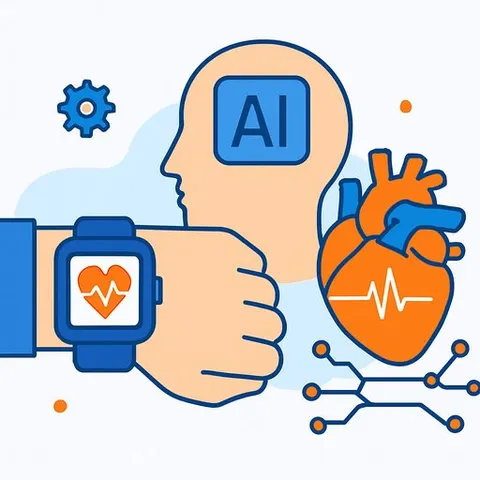
Wearable Makers Race to Predict Heart Attacks Years in Advance
Wearable device companies are building artificial intelligence models to forecast serious health events-sometimes years before they occur. The shift from tracking current fitness metrics to predicting future disease marks a turning point for an industry valued at over $90 billion.
Oura Health, maker of the Oura Ring, is collecting data from users to train models that predict heart attacks and strokes. The Finnish company is valued at about $11 billion after raising $875 million last September. Whoop, a Boston-based wearables company valued at $10.1 billion, says its models can warn of cardiac events as little as 15 minutes in advance.
Alphabet's Google, which owns Fitbit, launched a screenless band to compete with Whoop. Samsung Health is working to detect dementia using speech and gait analysis. Garmin partnered with the birth-control app Natural Cycles to pinpoint ovulation using skin temperature.
The appeal is straightforward. "The real breakthrough isn't knowing you had a problem," said Tom Hale, Oura's CEO. "It's knowing before you do, so you can change behavior and prevent it."
The Data Advantage and Its Limits
Wearables capture credible biometric data: respiratory rates, blood oxygen levels, sleep duration, heart rate variability, and more. These devices are increasingly mainstream-tennis players are now allowed to wear them at Grand Slam matches, and Health Secretary Robert F. Kennedy Jr. told Congress he wants every American to wear a wellness tracker.
But prediction requires far more rigor than monitoring. "The bar for prediction is much higher," said Joseph Schwab, director of surgical innovation and engineering at Cedars-Sinai Medical Center in Los Angeles.
No company has yet demonstrated that variations in the vast datasets they're building actually affect an individual's risk of chronic disease. "That's what we're aiming to do," said Hon Pak, head of digital health at Samsung, who is a physician and former chief medical information officer for the U.S. Army.
Regulatory Gaps Create Opportunity
The FDA hasn't loosened regulations barring wearables from diagnosing diseases or confirming medical conditions. But the industry is lobbying hard. Oura Health is advocating for a new U.S. classification that would allow wearables to alert users to potential health issues without undergoing the lengthy clearance process required for medical devices.
This regulatory gap means most health data collected by wearables sits outside HIPAA protections. Instead, terms of service govern the data, often allowing broad secondary uses. That creates both opportunity and risk.
Real Benefits, Real Concerns
Thomas Lynch of Florida said his Oura Ring "saved my life" after major surgery. The ring flagged an elevated heart rate, ultimately leading to his diagnosis of a pulmonary embolism.
Yet concerns about the technology are mounting. Wearable anxiety-where users cancel plans after sensors detect possible flu or congestion symptoms that never materialize-is documented across the internet. Frequent alerts can lead to unnecessary testing and doctor shopping.
The user base skews younger, wealthier, and more health-conscious. That means the data training these models may not reflect high-risk populations who could benefit most from early warning systems. Data breaches pose another threat. "A dystopia I always have is the advent of healthcare spam," said Kevin Fu, an expert in emerging sensor technology at Northeastern University College of Engineering and former acting director of medical device cybersecurity at the FDA.
Margaret Lozovotsky, who directs digital health innovations at the American Medical Association, warns that too much self-surveillance could shift responsibility for monitoring from medical experts to individuals with little medical literacy. James Gilmore, author of "Bringers of Order: Wearable Technologies and the Manufacturing of Everyday Life," said the mindset that "I'm only as good as the data that I produce" might encourage dangerous responses.
Users Accept the Trade-off
Not all users share these concerns. Haley Billey, a 31-year-old manager in Michigan, discovered she had Hashimoto's disease after her Oura Ring flagged unusual stress and energy levels. She's now enrolled in Oura's hypertension study.
"If a company knows my blood pressure and heart rate and everything, I'm comfortable with it at the moment," Billey said. She added, "I hope I don't eat my words."
As a data scientist who works with AI daily, Lynch said he'll take predictions of future health events with "a grain of salt."
For more on how AI is being deployed in healthcare settings, see AI for Healthcare and AI Data Analysis.