
AI news ·
United States immigration agency uses artificial intelligence to cross-reference applications with historical and public records
USCIS uses AI to cross-reference immigration petitions against 10 years of data. Employers must ensure strict consistency across corporate records to avoid visa denials.
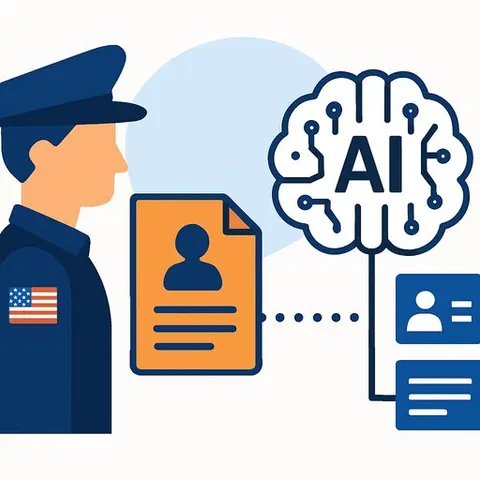
U.S. immigration adjudications are shifting from document-driven reviews to data-driven investigations, with USCIS officers using AI tools to cross-reference filings against multiple government databases and public online information. As of July 2026, employers and foreign nationals should assume every immigration petition is scrutinized for inconsistencies across years of historical data, making credibility and documentation more critical than ever.
AI Expands the Scope of Review
USCIS officers now compare information across prior visa applications, DS-160 and DS-260 forms, I-129 and I-140 petitions, CBP travel records, SEVIS and SAVE databases, Social Security data, and previous immigration benefits. Statements made years earlier may be reviewed alongside a current filing. This means immigration filings should no longer be prepared in isolation.
Historical DS-160 applications filed eight or ten years ago are receiving renewed scrutiny. Job titles, employment dates, educational history, salary information, and addresses from old forms are compared against current petitions. Minor inconsistencies that once went unnoticed can now generate questions. Applicants often do not remember what they entered on a DS-160 years ago, but USCIS and the Department of State still hold those records. Inconsistencies should be anticipated and explained whenever appropriate.
The growing role of AI for Legal in immigration adjudications means that officers can cross-reference information from multiple government databases almost instantly. Modern analytical systems compare filings against government records, public corporate filings, LinkedIn profiles, company websites, SEC filings, and news articles. Employers should assume publicly available information may be reviewed during adjudications.
Requests for Evidence Become More Demanding
Across nearly every employment-based category, Requests for Evidence (RFEs) have become longer, more technical, and more fact-intensive. Rather than requesting one missing document, officers now challenge multiple aspects of eligibility simultaneously. Many RFEs now read like litigation briefs, demanding corroborating evidence, third-party documentation, financial records, and objective proof rather than assertions.
National Interest Waiver and Extraordinary Ability cases face higher evidentiary expectations. Officers increasingly seek measurable evidence of impact, such as citation analysis, independent media coverage, commercialization evidence, licensing agreements, and implementation of research. General statements about importance are often insufficient.
Compliance Must Span the Entire Organization
Government agencies now share information across traditional boundaries. USCIS, ICE, CBP, the Department of Labor, the IRS, and the Social Security Administration may compare payroll, tax reporting, wage compliance, and corporate ownership data with immigration filings. Employers should expect greater consistency between immigration petitions and employment records.
One inconsistent filing can create problems for multiple future petitions. Common issues include different employee titles, conflicting organizational charts, changing job descriptions, and inconsistent ownership information. Large employers should centralize immigration preparation to ensure consistency across HR, payroll, legal, recruiting, and finance.
Employers can use AI for Human Resources to identify inconsistencies across filings before the government does. AI tools can review organizational charts, compare position descriptions, check corporate websites for conflicting information, and audit public employee profiles. Human legal review remains essential, but AI helps organizations spot issues early.
Practical steps for employers include:
- Conduct internal immigration compliance audits.
- Review historical filings for consistency before submitting new petitions.
- Standardize job descriptions and organizational charts.
- Coordinate immigration counsel with HR, payroll, finance, and recruiting teams.
- Regularly audit Forms I-9 and E-Verify procedures.
- Preserve supporting documentation contemporaneously rather than reconstructing it during an RFE.
- Review executives' and sponsored employees' public profiles for consistency with immigration filings.
- Develop protocols for responding quickly to RFEs and Notices of Intent to Deny (NOIDs).
- Train managers on the increased scrutiny surrounding employment-based sponsorship.
- Consider using AI-powered compliance tools, subject to appropriate legal oversight, to identify inconsistencies before filing.
Why this matters for Human Resources
Immigration compliance can no longer be viewed as a series of isolated filings. It must be managed as an enterprise-wide risk function that integrates legal strategy, HR, payroll, tax, corporate governance, and document management. For HR professionals, accuracy, transparency, and consistency across every immigration filing-from a decade-old DS-160 to today's immigrant petition-are now essential. Organizations that invest now in strong compliance systems, proactive audits, and careful documentation will be best positioned to handle an immigration process where every filing may be measured against years of historical data and a growing universe of digital information.