
AI news ·
Wolters Kluwer survey finds AI reshapes legal workflows but leaves human judgment central to the profession
AI is automating legal drafting and research fast, but lawyers aren't disappearing. Judgment, negotiation, and client relationships are growing in value as routine tasks get handed off to machines.
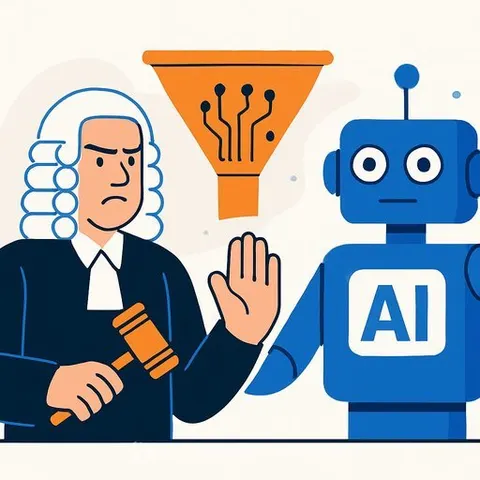
AI Is Automating Legal Drafting and Research. Lawyers Aren't Going Anywhere.
Routine legal tasks are being displaced by AI at a rapid pace, but the profession remains vibrant and in demand. A new survey of legal professionals across the U.S. and Europe found that initial drafts and research work are disappearing fastest, while the skills that machines cannot replicate-judgment, negotiation, relationship-building-are becoming more valuable.
The shift is forcing law firms and corporate legal departments to rethink how work gets done and what lawyers actually do. A Wolters Kluwer survey of legal professionals in the U.S., China, and nine European countries captured a profession restructuring itself in real time.
The Human Element Remains Essential
Justin Wales, head of legal for The Americas at Crypto.com, said he's seeing initial drafts and research "being displaced very, very quickly." But he doesn't expect lawyers to disappear. The value lawyers bring often comes from knowing the judge, the regulator, or the person on the other side-difficult for a machine to replicate.
Wales expects billing rates to rise for lawyers on the communicative side of legal work. Commercial deals, regulated environments, and litigation involve far more than research and drafting.
The real pressure is on junior lawyers. Their traditional path-drafting under supervision, learning through feedback-has compressed dramatically. Maria Dymitruk, head of AI law department at Lubasz & Partners, said what used to take days now happens in seconds. Young lawyers now spend their time evaluating AI output, a cognitively demanding task that requires significant judgment and responsibility.
Tasks Are Unbundling, Not Disappearing
Legal work is being broken into smaller subtasks. Machines handle some; lawyers focus on higher-value client engagement. Philipp Mueller, senior vice president of product management at Wolters Kluwer Legal & Regulatory, said this unbundling is reshaping how law firms and in-house teams operate.
One consequence: clients arrive at lawyers' offices more informed-though not necessarily better informed. Mueller flagged a gap where fact-checking and verification could play a role, and questioned what regulation might look like.
Benedikt Quarch, co-director of the German Legal Tech Hub, observed that the knowledge gap between lawyers and clients is shrinking. Before AI, lawyers held a monopoly on legal knowledge. That advantage is eroding. The profession is shifting toward negotiation, strategy, and relationship work instead of pure knowledge transfer.
In-House Teams Are Keeping More Work
Law firms that integrate closely with corporate legal departments' workflows see better results. When firms embed themselves in the central systems of in-house teams, operations run smoother, fewer emails clog inboxes, and more work stays in-house rather than going to outside counsel.
Quarch said this strategy works for everyone. Law firms still have plenty of work, just in a different arrangement.
The Pipeline Debate
Panelists disagreed on how AI will affect junior lawyer development. Rajiv Arora, vice president of technology product management at Wolters Kluwer, suggested that synthetic data and curriculum changes could compress what took two years of learning into six months or less. Law school graduates might enter practice already knowing basics that took junior attorneys years to absorb.
Wales rejected this view. He said there's no way to shortcut the traditional attorney learning process-the struggle of being bad at your job, then learning from people who've been through the same trials.
The disagreement reflects a broader reality: there are no universal answers yet. Both positions likely have merit as the profession continues to evolve.
What Lawyers Need Now
Success in an AI-driven legal practice requires continuous learning, strong compliance frameworks, and a culture of adaptability. The lawyer's role is shifting from reactive adviser to proactive decision-making partner. Dymitruk emphasized that lawyers must remain the human in the loop-evaluating outputs and taking responsibility for outcomes.
For those in legal roles, the skills to develop are evaluation, judgment, client communication, and the ability to work alongside AI tools rather than compete with them. Learn more about AI for Legal professionals and explore resources like the AI Learning Path for Paralegals.