AI agent for statisticians
Research Analysis Assumption Agent
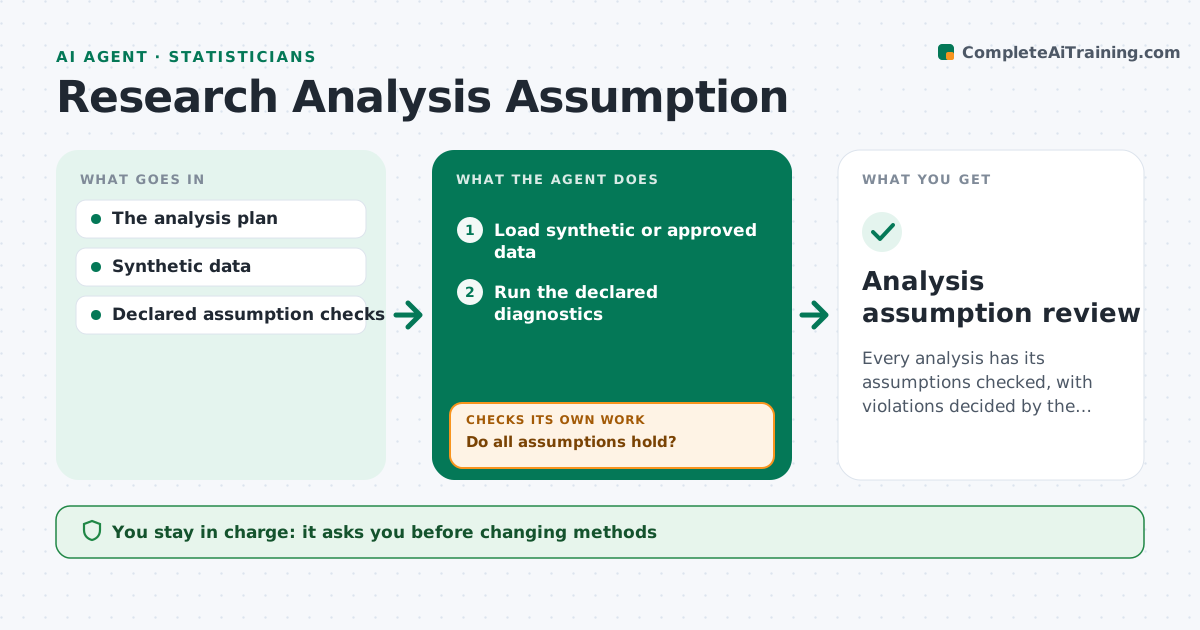
Every analysis has its assumptions checked, with violations decided by the investigator.
What it does
Analysis scripts often run without checking the statistical assumptions they depend on, so results can look solid when they are not. This agent runs the declared diagnostics, such as normality, independence and equal variance, on synthetic or approved data before the main analysis. When it sees a violation, it runs follow-up diagnostics to understand how serious it is and what causes it. It then prepares a review with supported alternatives, such as robust standard errors or a different test, and the evidence behind each. It never silently switches to a different method; the investigator chooses. Edge case: a mild violation within the stated tolerance is reported but does not block the planned method.
How it works
Follow the arrows from top to bottom. The orange dashed arrow is the loop: when a check fails, the agent goes back and tries again.
Read the steps as a list
- Analysis planned
- Load synthetic or approved data
- Run the declared diagnostics
- Do all assumptions hold?If not: run follow-up diagnostics to characterise the violation. Back to step 3.
- Prepare supported alternatives
- Investigator chooses the methodThe agent waits here for your OK.
- Record the decision in the analysis log
- Analysis assumption review
How it decides
It chooses follow-up diagnostics based on observed violations.
- Never switch methods without the investigator.
- Violations within tolerance are reported, not blocking.
- Every alternative comes with its evidence.
- Only synthetic or approved data is used.
Make it yours
Every agent is a starting point. You choose these settings for your own situation.
- Diagnostics to run per analysis type
- Tolerance for each assumption
- Data the agent may use (default: synthetic or approved extracts)
- Who chooses the method (default: investigator)
- Review format
What keeps you in control
It always asks you first
- Changing methods
- Scientific inference
Hard limits
- Sandbox only.
It stops when
- Done: review ready.
Set it up
We guide you through the set-up, step by step
Members get the full set-up guide for this agent. No technical skills needed: you copy, paste and upload.
- One set of instructions to paste into your AI, with the clicks for ChatGPT, Claude, Microsoft 365 Copilot, Gemini and Grok
- The agent then walks you through connecting your own data, one source at a time
- A downloadable copy with the flow chart, the rules and the full guide