AI agent for user experience designers
User Test Prototype Iteration Agent
Turn test observations into ranked problems and verified changes for the next prototype.
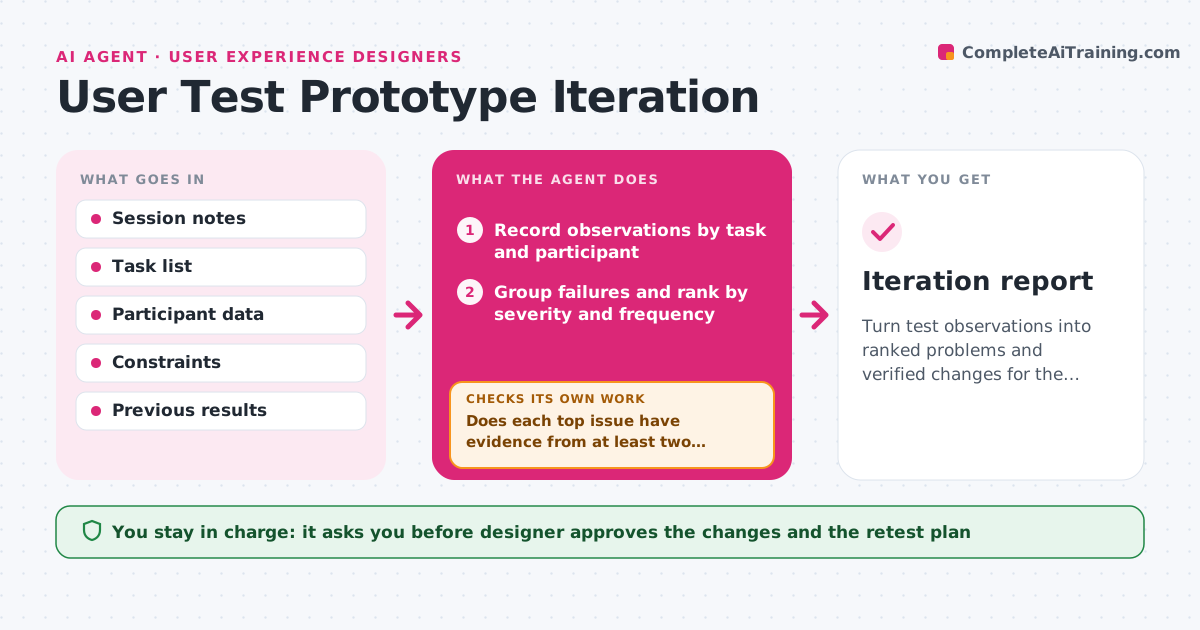
What it does
After testing a prototype with eight people, the team remembers the loudest comment and fixes that, while the real problem, a latch that five people struggled with, is ignored. This agent records observations by task for each participant, such as success, time, errors and quotes. It groups failures across participants and ranks them by severity and frequency. For the top issues it proposes design changes and checks each one against constraints, such as cost, material, size and safety. It checks that every top issue has at least two pieces of evidence and a proposed change, and sends weak ones back for more evidence. It plans a retest with the same tasks. After the retest, it compares results and confirms the issue is fixed. The designer approves the changes. Edge case: a fix conflicts with a safety rule, so the agent rejects it.
How it works
Follow the arrows from top to bottom. The orange dashed arrow is the loop: when a check fails, the agent goes back and tries again.
Read the steps as a list
- User test session ends
- Record observations by task and participant
- Group failures and rank by severity and frequency
- Does each top issue have evidence from at least two participants?If not: mark it as a possible issue and plan extra observation. Back to step 3.
- Propose design changes for the top issues
- Check each change against cost, size and safety constraints
- Plan the retest with the same tasks
- Designer approves the changes and the retest planThe agent waits here for your OK.
- Record results of the retest
- Did the failures on the top issues drop to the target?If not: propose a different change and plan another retest. Back to step 5.
- Iteration report
How it decides
It ranks problems by how many people failed and how badly. A change is considered only if it fits cost, size and safety constraints.
- Rank an issue higher when 3 or more participants fail the same task
- Treat an issue with one witness as possible, not confirmed
- Reject any change that breaks a safety or cost constraint
- Set a retest target of at most one failure in the group
Make it yours
Every agent is a starting point. You choose these settings for your own situation.
- Tasks to record
- Severity scale
- Constraints list
- Retest group size (default 6)
- Target failure level
What keeps you in control
It always asks you first
- Designer approves the changes and the retest plan
Hard limits
- Never approve a change that breaks safety rules
- Never treat a single comment as a finding
It stops when
- Done: top issues are fixed in the retest
- Stop: no change fits the constraints, so the designer decides on a trade-off
Set it up
We guide you through the set-up, step by step
Members get the full set-up guide for this agent. No technical skills needed: you copy, paste and upload.
- One set of instructions to paste into your AI, with the clicks for ChatGPT, Claude, Microsoft 365 Copilot, Gemini and Grok
- The agent then walks you through connecting your own data, one source at a time
- A downloadable copy with the flow chart, the rules and the full guide