AI tool
FastRouter.ai
FastRouter.ai provides a unified API for routing requests across major AI providers like OpenAI, Anthropic, and Google. It is for teams running AI in production who want to reduce integration overhead and get proactive cost and model-switching rec...
About FastRouter.ai
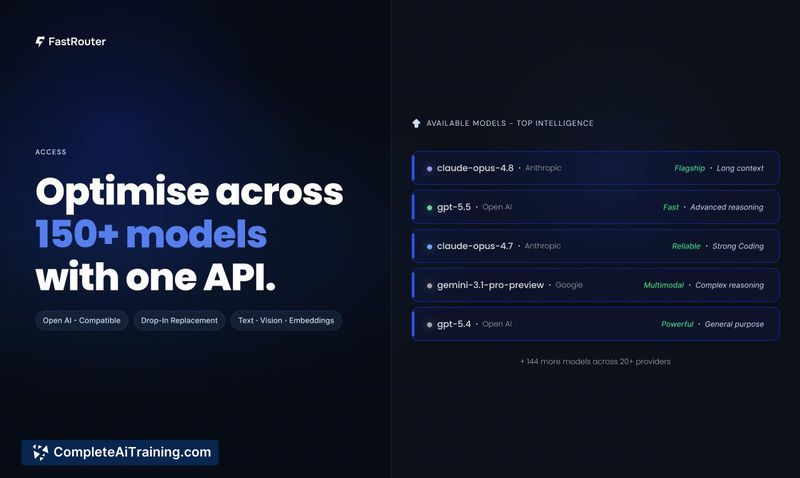
FastRouter.ai is a unified AI gateway and control plane that routes requests across 200+ LLMs through a single OpenAI-compatible API. It applies intelligent routing, failover, observability, and governance so development teams can scale applications without managing multiple SDKs or vendor-specific integrations. The platform also surfaces cost-saving recommendations and quality evaluations based on real production traffic.
Review
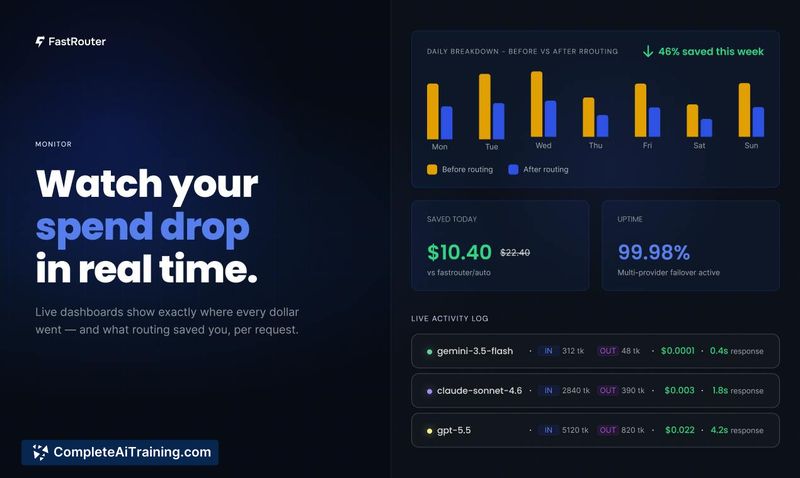
FastRouter.ai entered the market with a clear focus on what happens after teams connect their models-namely, making sense of cost, latency, and quality data and acting on it. Rather than stopping at a unified API, the tool emphasizes what it calls Routing Intelligence: weekly insights, anomaly alerts, and model-switch suggestions backed by custom evaluations. The result is a gateway that doesn't just move traffic, but flags concrete changes a team can make to reduce spend or avoid degraded performance.
Key Features
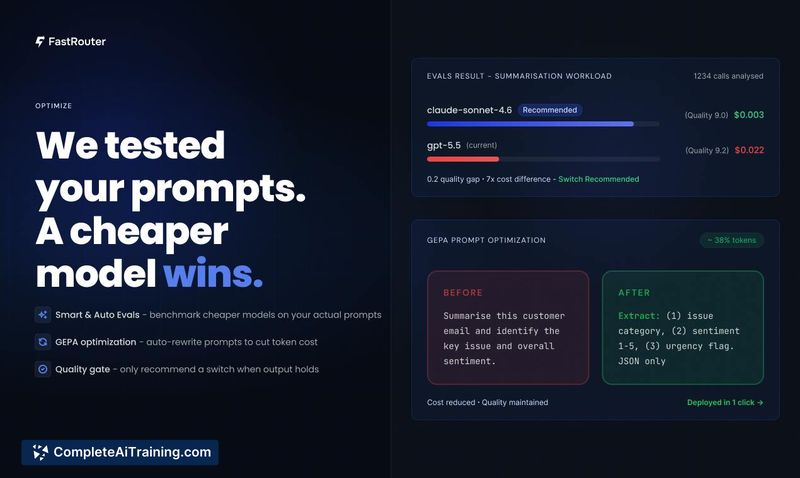
- Proactive Insights with model-switch recommendations. Weekly audits of production traffic identify prompt caching opportunities, flex-tier usage, and cheaper models that maintain output quality. Recommendations include evaluation scores so teams can compare before switching.
- Custom Evaluations across text, image, and video. Users can evaluate production logs and datasets side-by-side, comparing model outputs beyond simple HTTP success. The feature supports multimodal content, which matters for teams generating images or video.
- Virtual Model Aliases with configurable routing policies. Aliases let teams set rules like Lowest Latency, Lowest Price, Priority Routing, or Random Shuffle. A request can hit a primary provider and fall back only on failure, or always pick the cheapest option from a selected set.
- Multimodal observability and response caching. Requests and responses-including image and video outputs-appear in logs. A caching layer reuses matching multimodal responses instead of calling the model again, which can cut costs on repeated prompts.
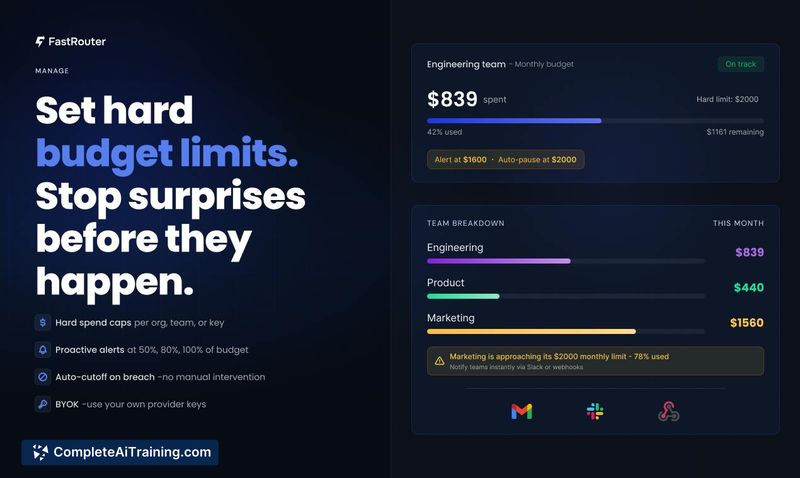
- Real-time alerts and rate limiting. Threshold and percentage-based alerts for latency, error, and spend anomalies reach Slack or PagerDuty. Rate limits apply at both the API key and project level, with budget caps available.
Pricing and Value
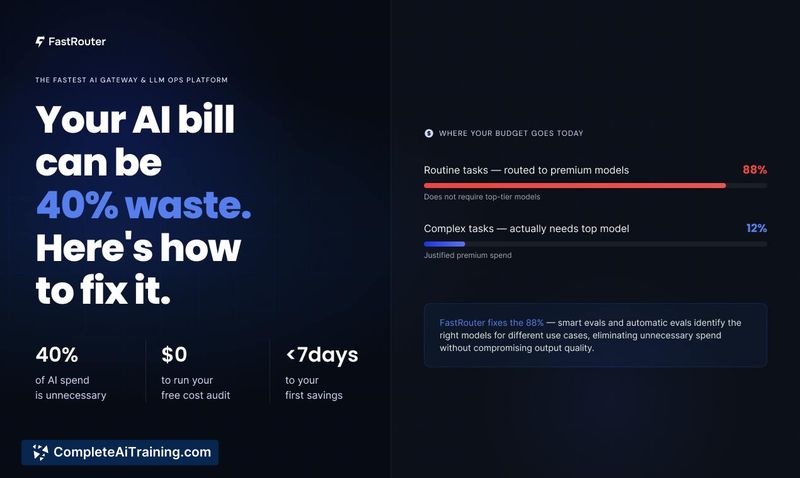
FastRouter.ai offers a free tier alongside a SaaS deployment. An on-premises option exists for enterprise customers who need to run the gateway in their own cloud environment. The makers state that production customers have identified over $10,000 per month in savings by acting on the platform's recommendations. Specific plan pricing beyond the free tier is not publicly listed at this time.
Pros
- One OpenAI-compatible API replaces direct integrations with Anthropic, Bedrock, Vertex AI, and other providers, reducing SDK sprawl.
- Failover logic handles provider outages before the first token is sent, retrying on another upstream without surfacing errors to the client.
- Prompt management includes versioning, rollback, and compression tools kept in a shared library.
- Content logging can be disabled per API key, and the enterprise deployment supports running entirely on-premises.
- Optimization Settings are planned for imminent release, allowing per-model choices like always using the flex tier or applying prompt compression.
Cons
- Streaming failover only triggers before the first token. If a provider errors mid-stream, the client receives the error and must restart-no transparent continuation is available.
- Disabling content logging removes that traffic from Insights, Evaluations, and Prompt Optimization features, creating a trade-off between privacy and the tool's analytical capabilities.
- The platform is not well suited for teams that use a single provider with stable pricing and don't need cross-model routing. The routing intelligence layer adds the most value when multiple models or providers are in play.
FastRouter.ai fits teams that run workloads across several LLM providers and want a centralized layer to handle failover, cost tracking, and model quality comparisons without changing application code. The weekly insights and multimodal evaluations make it particularly relevant for organizations where production traffic is high enough that small per-request savings add up. Teams with simpler setups or a single trusted model may find the additional control plane more than they need.
Jobs FastRouter.ai suits
We checked FastRouter.ai against 500+ jobs; these get the most out of it.