AI tool
Lingo.dev v1
Lingo.dev v1 lets teams build stateful localization APIs-glossaries, brand-voice rules, per-locale model chains and AI quality scoring-accessible via API, CLI, CI/CD or MCP.
About Lingo.dev v1
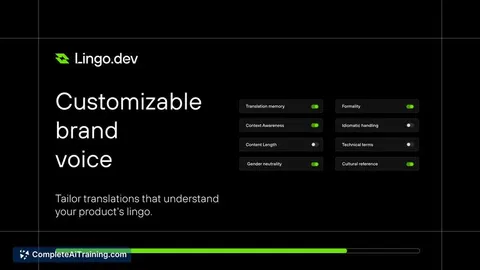
Lingo.dev v1 is a localization engineering platform that helps teams build stateful translation engines with configurable glossaries, brand voice rules, per-locale model chains, and AI-based quality scoring. It provides multiple integration points - API, CLI, CI/CD and MCP - so localization can be called from development workflows and automation pipelines.
Review
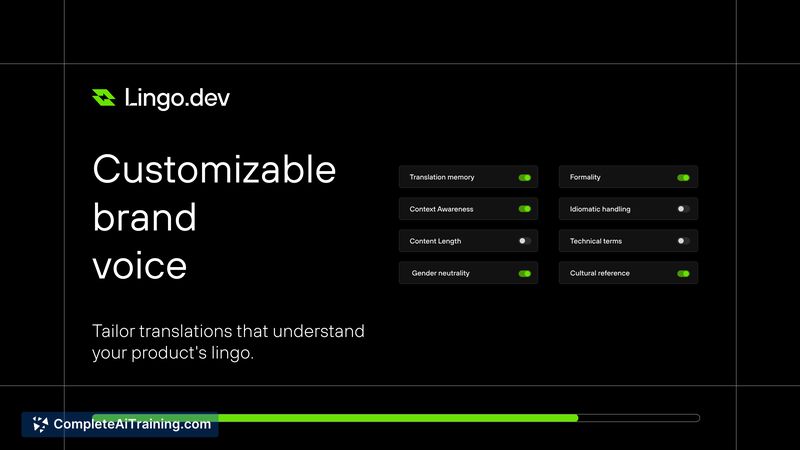
This release focuses on solving consistency and quality gaps that arise when using raw large language models for translation. By keeping configuration and context attached to each localization engine, Lingo.dev v1 aims to reduce terminology drift and make automated translations repeatable across releases.
Key Features
- Stateful localization engines: preserve glossary, brand voice, and instructions so each request retains prior context.
- Glossary injection at inference: source-to-target term mappings are applied automatically per locale pair to improve consistency.
- Per-locale model chains and fallbacks: configurable model ranking per locale so teams can switch providers without reworking glossaries.
- AI reviewers and quality scoring: separate models can score translations on multiple dimensions to support automated QA at scale.
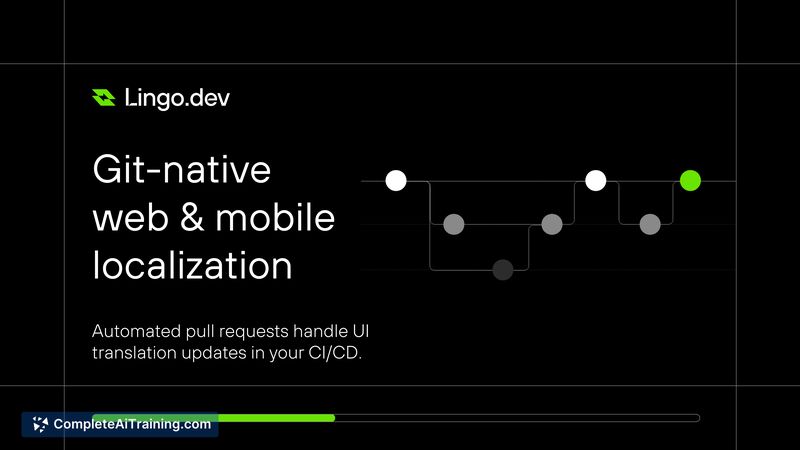
- Developer integrations: synchronous APIs, async jobs with webhooks, CLI tooling, GitHub/CI integrations and MCP support for automation.
Pricing and Value
Lingo.dev v1 lists a free option and targets developer-centric workflows, but detailed commercial pricing is not fully exposed on the product listing. The platform's value proposition centers on reducing recurring costs from re-training or over-spending on higher-cost models by improving translation quality through configuration and context. Published research from the team reports that retrieval-augmented localization (RAL) reduced terminology errors by roughly 16.6-44.6% across multiple providers and languages, suggesting potential cost-quality tradeoffs if you leverage glossary injection and model chaining thoughtfully.
Pros
- Clear focus on consistency: glossary and brand voice rules help avoid terminology drift across releases.
- Engine-level configuration: once set up, engines retain context so future translations stay aligned with prior decisions.
- Multiple integration points for engineering teams: API, CLI, CI/CD and webhook workflows are supported.
- Built-in AI scoring enables scalable, automated quality checks instead of relying entirely on manual review.
- Per-locale model chaining provides flexibility to use different providers or fallbacks without reconfiguring content rules.
Cons
- Pricing details and tiers are not clearly posted in the product listing, which can make procurement planning harder.
- Less suited for single, one-off translations where consistency and statefulness are not required.
- Teams that rely primarily on human-led review workflows may find the platform's automation-oriented approach a mismatch for their process.
Overall, Lingo.dev v1 is best suited for engineering teams and product teams that need consistent, repeatable localization across many releases and locales. If you manage product translations at scale and want integration with developer workflows, it's worth evaluating; if your needs are occasional or strictly human-only review, a lighter-weight or manual approach may be preferable.
Jobs Lingo.dev v1 suits
We checked Lingo.dev v1 against 500+ jobs; these get the most out of it.
Alternatives to Lingo.dev v1
Other tools that do the same main job. Our AI compared Lingo.dev v1 with similar tools and kept the ones you could use instead.