AI tool
Trinity-Large-Thinking by Arcee
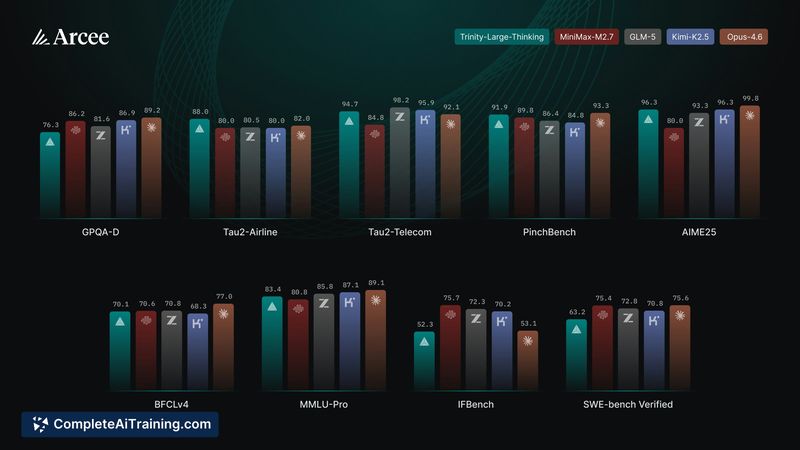
Trinity-Large-Thinking by Arcee: an open-source SOTA model for developers who want models they can inspect, post-train, host, distill and own. Ranked #2 on PinchBench (KiloClaw); $0.90 per 1M output tokens (~96% cheaper).

About Trinity-Large-Thinking by Arcee
Trinity-Large-Thinking by Arcee is a recently released open-weight large language model aimed at developers and researchers who want an inspectable and modifiable model. It combines high benchmark-level performance with a low-cost inference option and an open licensing approach.
Review
This review summarizes the model's capabilities, pricing, and practical trade-offs for teams evaluating open models for development or deployment. I focus on performance claims, usability for fine-tuning and hosting, and the expected operational considerations.
Key Features
- Open-weight distribution with a permissive license that allows inspection and modification.
- Performance reported to be comparable to top-tier models on common benchmarks.
- Very low inference pricing at approximately $0.90 per million output tokens, advertised as about 96% cheaper than comparable offerings.
- Workflows supported for fine-tuning (post-training), self-hosting, and model distillation.
- Targeted at developers who want to own and control model weights and deployment.
Pricing and Value
Pricing is a standout point: the stated cost is roughly $0.90 per million output tokens, positioning the model as a much more affordable option than many alternatives. For teams that perform large-scale inference or require long-running experiments, that pricing can materially reduce operating expenses.
Value depends on your priorities. If you need full control of model weights, the open distribution reduces vendor lock-in and allows deeper customization. However, total cost of ownership should factor in hosting infrastructure, GPU capacity for inference or fine-tuning, and engineering effort for production hardening.
Pros
- Open-weight release enables inspection, modification, and local hosting.
- Competitive benchmark performance relative to leading models.
- Very low announced inference cost makes large-scale usage more affordable.
- Supports common developer workflows like fine-tuning and distillation.
- Good fit for teams that prioritize model ownership and transparency.
Cons
- Being newly launched, the ecosystem and third-party integrations are still developing; early adopters may encounter rough edges.
- Self-hosting and fine-tuning require significant compute and ops resources, which can offset inference cost benefits for smaller teams.
- Documentation and community tooling are likely to evolve rapidly; expect updates and potential breaking changes.
Overall, Trinity-Large-Thinking by Arcee is well suited for developers, research teams, and organizations that need an inspectable, finetunable model and want to reduce per-token inference costs. It may be less suitable for users who prefer fully managed turnkey services or who lack the infrastructure and engineering bandwidth to self-host and maintain a model at scale.
Jobs Trinity-Large-Thinking by Arcee suits
We checked Trinity-Large-Thinking by Arcee against 500+ jobs; these get the most out of it.
Alternatives to Trinity-Large-Thinking by Arcee
Other tools that do the same main job. Our AI compared Trinity-Large-Thinking by Arcee with similar tools and kept the ones you could use instead.