AI app for it and development · no coding needed
Source-linked coding agent operations console
Reduce manual edit-run-fix work while keeping every agent action reviewable and inside the team's own environment.
Made for: Engineering teams and technical leads running AI coding agents on their own codebases
What it does for you
The problem
Coding agents are scattered across several rented tools, so runs, fixes and approvals are hard to trace, reproduce or keep inside the team's own environment.
What it gives you
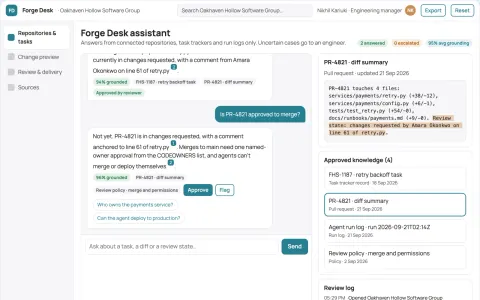
A source-linked agent run record with reviewed diffs and merge requests
What you give it
Repository accessbuildtest commandsruntime logsbrowser flowsapproval rules
Build your own version of Airuncode, Keen Code and more
One app with what these 7 AI tools do, yours to keep and change: Airuncode, Keen Code, Codex 3.0 by OpenAI, NOVA, Agen, Backgrind, SWE-Kit.
Everything these tools do, in one app
- AI coding agent An AI agent that performs software development tasks such as writing, testing, and debugging code.Found in Airuncode, Keen Code, Codex 3.0 by OpenAI and 4 more
- Local-first execution Runs the agent directly on the user's machine and works on local files.Found in Airuncode, Keen Code, Backgrind and 1 more
- Cloud-hosted agents Runs agents in the cloud without local installation, allowing continuous background work.Found in Agen, Codex 3.0 by OpenAI
- Multi-agent parallel execution Runs several coding agents at the same time, each able to use a different model.Found in Airuncode, Backgrind
- Codebase scanning and indexing Scans the codebase to build a global symbol map and AST index that agents use to understand code structure.Found in Airuncode
- Self-healing test failures Detects test failures and attempts automated fixes, with stack trace primacy and write-permission scope locking.Found in Airuncode, NOVA, Agen
- Automated error remediation Detects runtime errors or tracebacks and applies fixes automatically to shorten the edit-run-fix loop.Found in NOVA, Airuncode, Agen
- Multi-repository support Lets a single agent session make changes and open merge requests across several repositories.Found in Agen
- Scheduled agent runs Runs agents on a schedule for recurring or background tasks.Found in Agen
- Browser automation Simulates clicks, captures screenshots, and runs flow tests in a browser.Found in Codex 3.0 by OpenAI, SWE-Kit
- Cross-app computer control Performs actions like typing, clicking, and switching between applications.Found in Codex 3.0 by OpenAI
- Realtime debugging logs Uses console and network logs to identify and fix issues during runs.Found in Codex 3.0 by OpenAI
- File generation for office suites Generates and edits documents and spreadsheets in Microsoft Office and Google Drive.Found in Codex 3.0 by OpenAI
- In-terminal Git operations Commit, push, and pull without leaving the development environment.Found in NOVA
- Build from goal Describe what you want and the tool generates the necessary files and scaffolding.Found in NOVA
- Refactoring on demand Request refactors for individual files.Found in NOVA
- Context-efficient turn memory Discards raw tool inputs/outputs after each turn and passes a compact struct to keep context lean across multi-turn sessions.Found in Keen Code
- Lazy-loaded MCP skills Represents MCP tools as local markdown Skills and lazy-loads JSON schemas only when requested.Found in Keen Code
- Floating overlay window An always-on-top window that floats the agent above any desktop application, including fullscreen games.Found in Backgrind
- Voice input on-device Transcribes voice input locally with whisper.cpp so audio never leaves the machine.Found in Backgrind
- Bring your own agent Works with existing CLI agents like Claude Code, Cursor, or Codex, or provides a built-in agent.Found in Backgrind
- Framework-agnostic agent building Works with frameworks such as LangChain, LlamaIndex, CrewAi, and Autogen to build custom agents.Found in SWE-Kit
- Third-party integrations Connects with platforms like GitHub, Slack, Jira, and Gmail for end-to-end automation.Found in SWE-Kit
- Flexible deployment Can be deployed locally using Docker or on remote servers.Found in SWE-Kit
- Vulkan 3D runtime A native Vulkan 3D runtime that gives agents access to rendering, terrain, and physics systems for game development.Found in Airuncode
How it works, step by step
- Run a coding agent that writes, tests and debugs code
- Execute locally on the user's machine against local files
- Run cloud-hosted agents for continuous background work
- Run several agents in parallel, each on a chosen model
- Scan and index the codebase into a symbol map and AST index
- Detect test failures and attempt fixes with stack trace primacy and write-scope locking
- Detect runtime errors and apply fixes to shorten the edit-run-fix loop
- Make changes and open merge requests across several repositories in one session
- Schedule recurring agent runs
- Drive a browser to click, capture screenshots and run flow tests
- Perform cross-app actions such as typing, clicking and switching applications
- Read console and network logs during runs to locate issues
- Generate and edit documents and spreadsheets in Office suites
- Commit, push and pull from inside the terminal
- Generate files and scaffolding from a stated goal
- Refactor individual files on request
- Keep turn memory compact by discarding raw tool output and passing a struct
- Represent MCP tools as local markdown skills and lazy-load schemas
- Float an always-on-top agent window above other applications
- Transcribe voice input on-device so audio never leaves the machine
- Work with existing CLI agents or a built-in agent
- Build custom agents with common frameworks
- Connect GitHub, Slack, Jira and Gmail for end-to-end automation
- Deploy locally with Docker or on remote servers
- Give agents a Vulkan 3D runtime for rendering, terrain and physics work
- Compare the reviewed result with the recorded baseline and value assumptions
- Capture corrections and named-owner approval before consequential use
- Export a versioned source-linked agent run record with reviewed diffs and merge requests, source references and unresolved questions
Jobs this app suits
Our AI checked this app against 500 jobs; these get the most out of it. Each job links to its learning path.
Build it yourself with your AI system
Build this app yourself, no coding needed
Start with a quick version you can try in a few minutes. Like it? Then build the full app by copying and pasting our step-by-step instructions: everything is prepared for you.
Sign in to see how to build it yourself
Build a quick version to try, or get the full app pack for Source-linked coding agent operations console with the step-by-step building instructions. You don't need any technical skills: you copy, paste and answer a few questions. Both are included in the membership.
4 Have it built for you days to a few weeks
Rather not do it yourself, or want it fully tailored to your data, your way of working and your brand? Nexibeo builds Source-linked coding agent operations console with you.
What's in the app pack
Included in the Complete AI Training membership.
- The building instructions your AI follows, step by step
- The questions your AI will ask you about your business before it starts
- A clickable demo you can open in your browser, to see how it should work
- A detailed blueprint of the screens, the information it keeps and the checks it runs
Become a member to get the app packAlready a member? Sign in
The files, for the technically curious
- START-HERE.mdHow to build it with your own AI (read first)3 KB
- README.mdOverview and links5 KB
- questions.mdQuestions to answer before you build2 KB
- prompt-cloudflare.mdThe full build prompt, hosted on Cloudflare26 KB
- prompt-vps.mdThe same build on your own server (Docker)26 KB
- spec.jsonData model, API, AI pipeline, acceptance criteria12 KB
- demo/index.htmlThe working demo on sample data196 KB
Questions
Do I need to know how to code?
No. You copy and paste the prompts on this page into ChatGPT or Claude, and the AI does the building. When it asks you something, you answer in your own words.
What does it cost?
The quick version, the app pack and the step-by-step instructions are for members: you pay the membership price, not a price per app (see the plans). Building the full app uses your own ChatGPT or Claude subscription. Putting it online is often cheap or no cost at the start, and your AI tells you before anything costs money.
How long does it take?
The quick version: about two minutes. The real app: an afternoon for a first version you can use, longer if you want every feature.
Can I change it to fit my business?
Yes. Tell your AI what to change in plain words, like “add a column for the price” or “use our logo and colours”. Or have Nexibeo build and customise it for you.
More detailsHow the AI works, safeguards and what to build first
Reduce manual edit-run-fix work while keeping every agent action reviewable and inside the team's own environment. For engineering teams and technical leads running AI coding agents on their own codebases, convert repository access, build and test commands, runtime logs, browser flows and approval rules into a source-linked agent run record with reviewed diffs and merge requests. The benefit is a testable hypothesis, measured through accepted agent changes per engineering hour and rework after merge; do not assume that AI output alone produces business value.
Confirm the buyer's problem and scope, collect repository access, build and test commands, runtime logs, browser flows and approval rules, then follow this sequence: 1. Run a coding agent that writes, tests and debugs code. 2. Scan and index the codebase into a symbol map and AST index. 3. Detect test failures and attempt fixes with stack trace primacy and write-scope locking. 4. Detect runtime errors and apply fixes to shorten the edit-run-fix loop. 5. Make changes and open merge requests across several repositories in one session. Resolve uncertain cases with qualified reviewers, approve a source-linked agent run record with reviewed diffs and merge requests, and measure accepted agent changes per engineering hour and rework after merge against a documented baseline.
How the AI works
Use AI to interpret permitted inputs, suggest structured mappings and generate candidate outputs for the stated task modules. Use deterministic code for arithmetic, schema validation, hard constraints and reproducible tests. Review source-linked explanations and uncertainty before accepting results. One approved repository set and build environment; final code review and merge decisions remain with the engineering team. A model suggestion is never a verified fact, professional decision or authorization to act.
Safeguards
Preserve code ownership, source attribution, license accuracy and usage permissions. Engineering owners approve substantive changes and merge scope. One approved repository set and build environment; final code review and merge decisions remain with the engineering team. Keep all consequential actions under authorized human control and do not fabricate missing inputs, permissions, professional judgments or market evidence.
What to build first
Pilot scope: One approved repository set and build environment; final code review and merge decisions remain with the engineering team. Implement one approved input format, a bounded representative case set and the first two task modules: run a coding agent that writes, tests and debugs code; scan and index the codebase into a symbol map and AST index. Support the remaining modules with operator review: detect test failures and attempt fixes with stack trace primacy and write-scope locking; detect runtime errors and apply fixes to shorten the edit-run-fix loop; make changes and open merge requests across several repositories in one session. Include source references, corrections, basic organization access, approval states, export and value measurement. Use managed operator assistance for unresolved exceptions. The cost estimate covers this narrow prototype, not unrestricted multi-tenant scale, complex production integrations, specialist certification or physical operations.
What it can connect to
Team-owned repositories, CI systems and issue trackers. Cloud code hosting, chat and mail platforms, and document suites. Start with file exchange and validate destination specifications before promising direct publishing. Start with authorized file exchange. Validate current provider access, usage rights and schema behavior before promising a connector.
The screens in detail
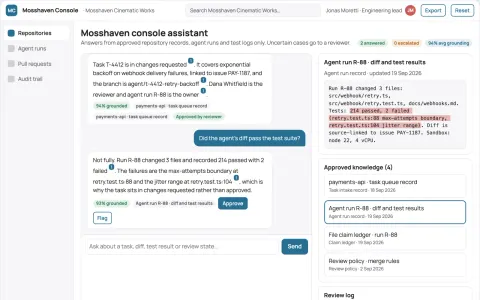
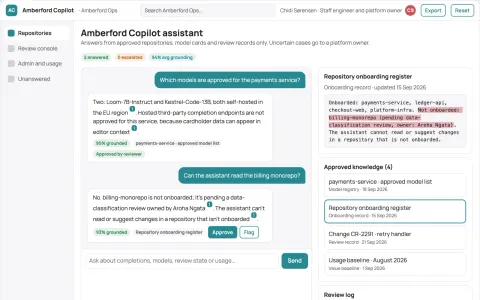
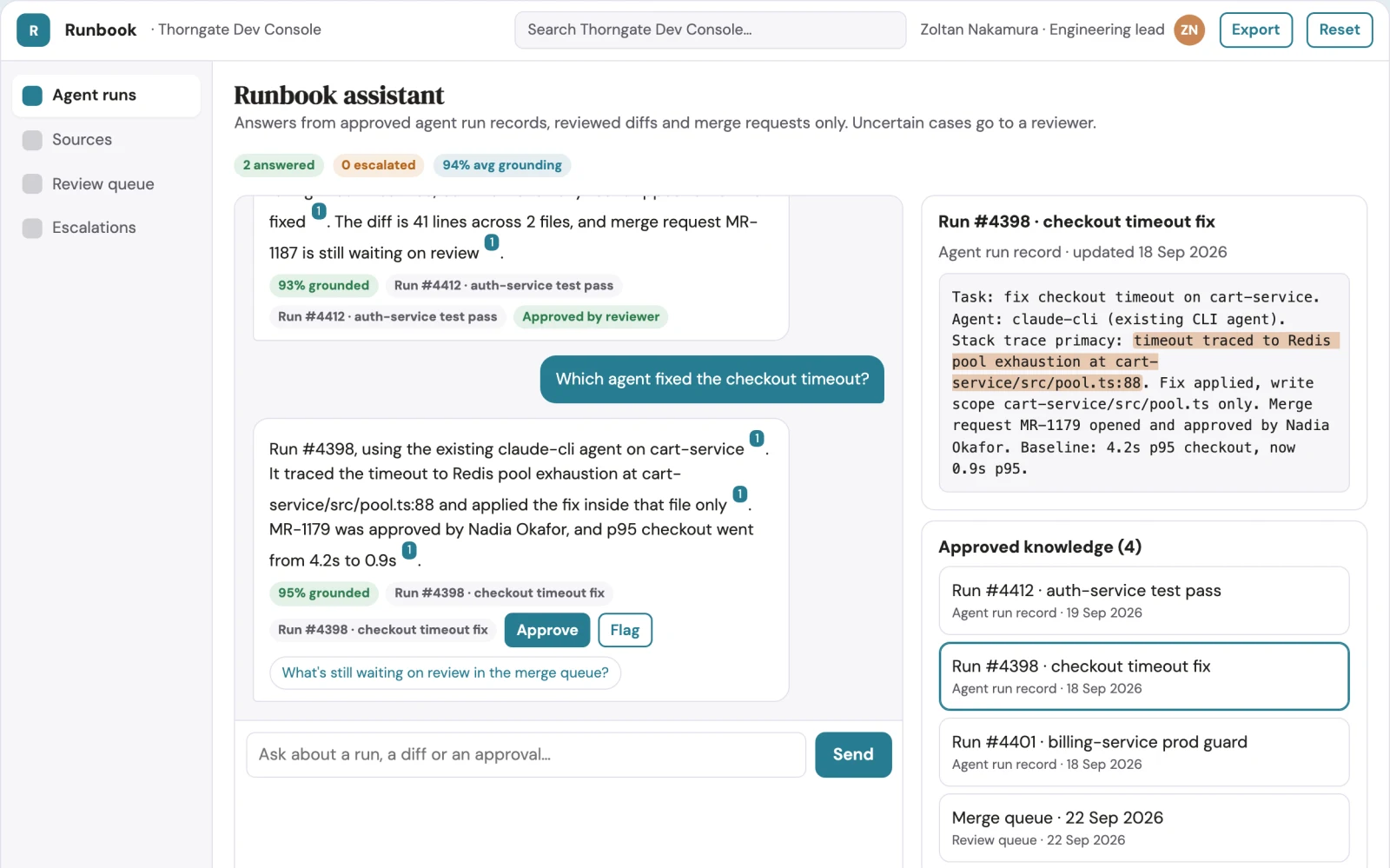
Primary screens: Agent run setup, Live run console, Review and merge queue. Use a repository and task list, a large central run timeline with diffs and logs, and a right-hand panel for permissions, model choice and approvals. Let users compare agent branches side by side. Display queued, running, needs review, approved and failed states. Provide a client or stakeholder preview link with comments anchored to the relevant diff. Make the task-specific outcome a source-linked agent run record with reviewed diffs and merge requests visible beside its evidence, review state and value baseline.