
Certification
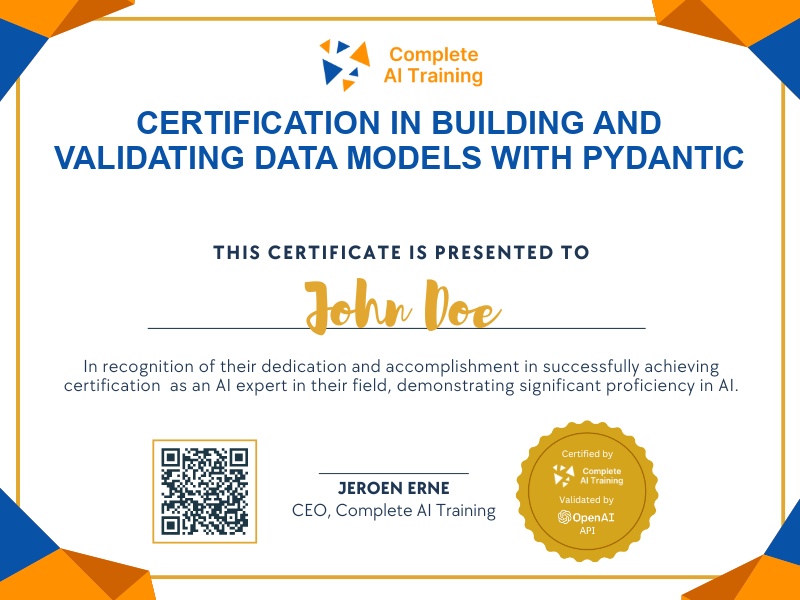
Certification in Building and Validating Data Models with Pydantic
Get certified in Pydantic data validation for Python and AI apps. Prove you can design strict models, write advanced validators, build schema-safe FastAPI APIs, validate LLM output, fail fast with clear logs, and ship production-ready services.
The exam
Take the certification exam
Multiple-choice questions about the course. Pass with 70% or more and your certificate is issued at once, with a public page and an "Add to LinkedIn" button.
What the exam covers
2 questions from each of the 8 chapters of the course
16 multiple-choice questions, drawn fresh for every attempt. Pass with 70% or more.
- 01Introduction to Pydantic10:38
- 02Type hints9:24
- 03Your first model9:13
- 04Validation and fields33:30
- 05Nested models1:12
- 06Pydantic Settings6:20
- 07Structured output with LLMs10:01
- 08Summary and next steps2:04
The Pydantic Crash Course: Data Validation for Python & AI Apps (Video Course) certification teaches you to make data contracts explicit so your code stays clean and your apps hold up in the real world.
You'll gain Increased Productivity, a clear Competitive Advantage, Improved Decision-Making, and Adaptability and Growth,skills that support a Future-Proof Career and even Higher Income Potential.
Enroll now to master Pydantic from the basics to advanced validators, nested models, FastAPI, and LLM output, so your Python and AI apps fail fast, log clearly, and perform reliably in production.
This certification covers the following topics:
- Core Pydantic models and Python type hints
- Field constraints, strict types, and custom validators
- Nested models and complex hierarchical schemas
- Serialization, deserialization, and computed fields
- Performance tuning and bulk validation
- Error handling, logging, and clear failure reporting
- Configuration management with pydantic-settings
- FastAPI integration for robust request/response models
- Enforcing structured LLM output in AI workflows
- Validation in ETL and data pipelines at every stage
- Testing strategies and avoiding common pitfalls
- Design principles, modeling patterns, and production best practices
Jobs this certification suits
Our AI checked this certification against 500 jobs; these get the most out of it. Each job links to its learning path.