MCP server · Developer tools
Proxmox MCP server
Lets your AI look after your Proxmox virtual machines and containers for you, in plain chat.
This is a helper that connects your AI assistant to Proxmox VE, the software many people use to run virtual machines and containers on their own servers. Once it is set up, you can ask your AI to list your machines, start or stop them, take snapshots, or make backups, instead of clicking around the Proxmox web page. It is handy for anyone who looks after a small server room or a home lab.
What is an MCP server? The 30-second version
On its own, your AI can only chat with you. An MCP server is a small helper program that gives your AI a new skill or a connection to another app. This one connects your AI to your Proxmox VE cluster, so it can look things up and do things there when you ask. You stay in the chat, and the helper does the talking to Proxmox behind the scenes.
What this MCP server does
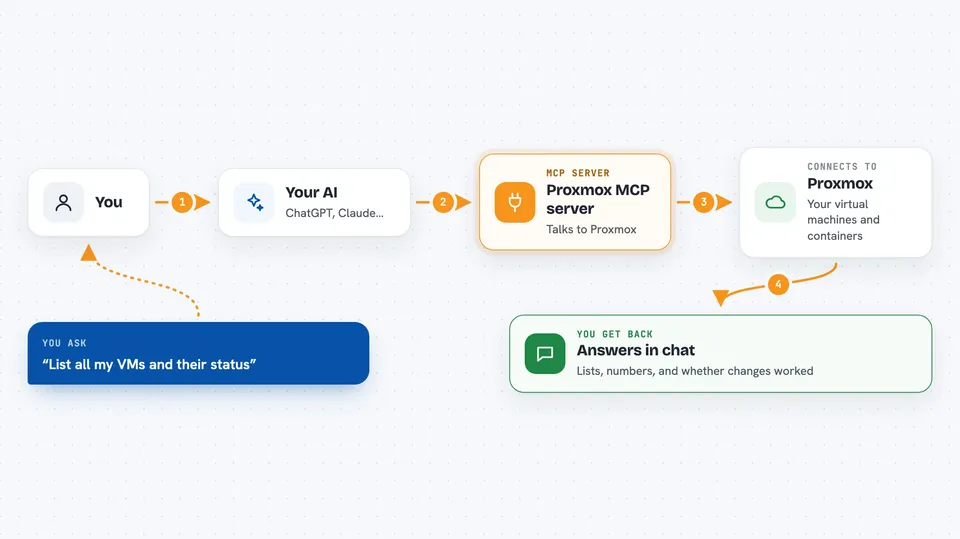
You type a request in plain words, like asking which virtual machines are running. Your AI passes that request to this helper program. The helper then talks to your Proxmox server using a special access token you set up. Proxmox sends back the answer, and the helper hands it to your AI, which explains it to you in the chat. For actions that change or delete things, the helper asks you to confirm first before it does anything.
 Click to zoom
What you can do with it
- List your virtual machines and containers with their status
- Start, stop, shut down, or reboot a machine
- Create and roll back snapshots
- Make and restore backups
- Create new virtual machines or containers from a template
- Check CPU, memory, and disk usage over time
- Add or change firewall rules
- Move a machine to another node in the cluster
Try asking your AI
- “List all my VMs and their status”
- “Create a snapshot of VM 200 called before-upgrade”
- “How much memory is VM 100 using?”
- “Back up VM 100 to the zfs-backup-storage”
What it gives back to you
You get answers in the chat, usually as short lists or summaries. For example, asking for your VMs gives you a list with names, numbers, and whether each one is running. Asking about memory gives you a number. When you make a change, like starting a machine or taking a snapshot, the helper tells you whether it worked.
Before you start
What you need
- A Proxmox VE server you can reach on your network
- An API token from Proxmox (a kind of password for apps; you create it in the Proxmox web page under Permissions > API Tokens)
- An AI assistant that supports MCP, like Claude Desktop, Claude Code, or Cursor
- Python and the uvx tool, or pip, to run the helper
Good to know
This helper can start, stop, change, and delete your virtual machines and containers, so only give it a token with the permissions you are comfortable with and read the confirmation warnings before saying yes.
Install it with your AI
Add Proxmox MCP server to your AI, no technical skills needed
You don't install anything by hand. You copy one prompt, paste it into an AI that can work on your computer, and it checks, installs and connects the server for you, asking you when it needs something.
Sign in to get the install prompt
Members get a ready-made prompt that lets the Claude desktop app check Proxmox MCP server, install it and connect it for them, step by step. You don't need any technical skills: you copy, paste and answer a few questions. Your connected AI can also find and install any of the 4,609 MCP servers here for you.
Who it's for
People who look after Proxmox servers, like home lab fans, small IT teams, and system administrators who want to manage things by chatting instead of clicking.