MCP server · Analytics
Brazilian Agriculture MCP server
Lets your AI look up Brazilian farm prices, crop estimates, climate and deforestation data for you.
This is a small helper that connects your AI assistant to public Brazilian agricultural data. Once it is set up, you can just ask questions in plain language about crop prices, harvest progress, weather or deforestation, and your AI will fetch the numbers for you. It is handy for anyone who follows Brazilian farming, food markets or the environment.
What is an MCP server? The 30-second version
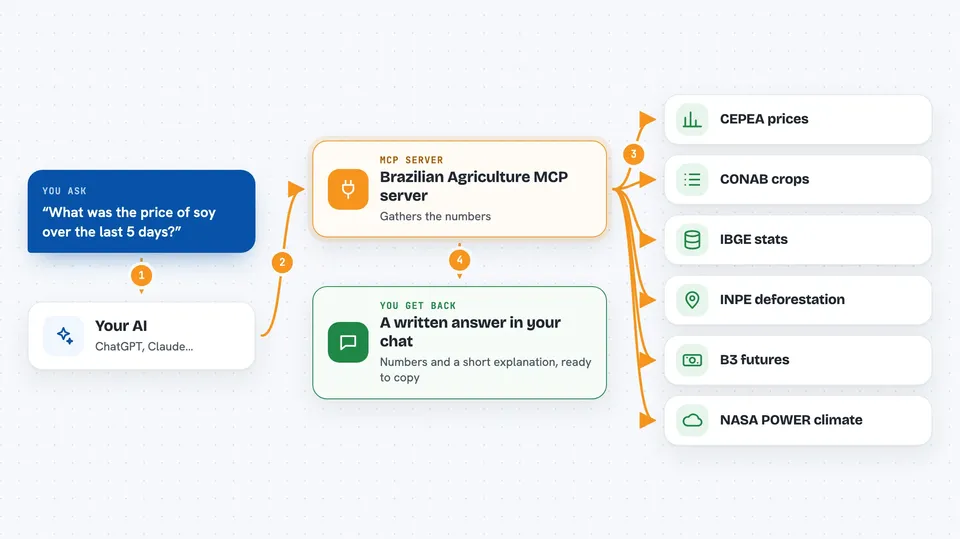
On its own, your AI can only chat with you using what it already knows. An MCP server is a small helper program that gives your AI a new skill or a connection to an outside service. This one connects your AI to Brazilian agricultural data sources like CEPEA, CONAB, IBGE, INPE and B3. So when you ask about soybean prices or harvest progress, your AI can actually go and look it up instead of guessing.
What this MCP server does
You ask your AI a question in normal words, like the price of soy over the last few days. Your AI passes that request to this helper program. The helper talks to public Brazilian data sources such as CEPEA, CONAB, IBGE, INPE, B3 and NASA POWER. It brings the numbers back and your AI writes them up for you in the chat. You get a clear answer without visiting any of those websites yourself.
 Click to zoom
What you can do with it
- Check daily spot prices for farm commodities like soy, corn and coffee
- Look up daily settlement prices for farm futures on the B3 exchange
- Get current crop season estimates by state
- See historical yearly production by state
- Follow weekly planting and harvesting progress
- Read climate data like temperature and rainfall by state
- Check deforestation rates and alerts by biome
Try asking your AI
- “What was the price of soy over the last 5 days?”
- “Show me the corn crop estimate by state”
- “How is the soy harvest progressing?”
- “What is the deforestation situation in the Amazon?”
What it gives back to you
You get answers written in the chat, usually with the numbers you asked for and a short explanation. Depending on the question, that can be a list of prices, a table of states and figures, a weekly progress summary, or climate and deforestation numbers. It is text you can read and copy, not a file to download.
Before you start
What you need
- Python installed on your computer
- An MCP client such as Claude Desktop, Cursor or Claude Code
- The agrobr-mcp package installed with pip
Good to know
The data comes from public sources that can be delayed or occasionally unavailable, so treat it as a quick reference and not as official trading advice.
Install it with your AI
Add Brazilian Agriculture MCP server to your AI, no technical skills needed
You don't install anything by hand. You copy one prompt, paste it into an AI that can work on your computer, and it checks, installs and connects the server for you, asking you when it needs something.
Sign in to get the install prompt
Members get a ready-made prompt that lets the Claude desktop app check Brazilian Agriculture MCP server, install it and connect it for them, step by step. You don't need any technical skills: you copy, paste and answer a few questions. Your connected AI can also find and install any of the 4,361 MCP servers here for you.
Who it's for
People who follow Brazilian farming, food markets or the environment, such as analysts, traders, journalists, students and researchers.