MCP server · Coding
GLM MCP server
by djerok
Lets your AI coding assistant hand the actual coding work to GLM, a much cheaper model, while it reviews.

This is a helper for people who use an AI coding assistant like Claude Code, GitHub Copilot, or Codex. Normally the expensive model does everything. With this connected, you can let a cheaper model called GLM do the actual file reading, editing, and running, while your main assistant stays in charge and checks the work. It is handy if you use your coding assistant a lot and want to keep the bill down.
What is an MCP server? The 30-second version
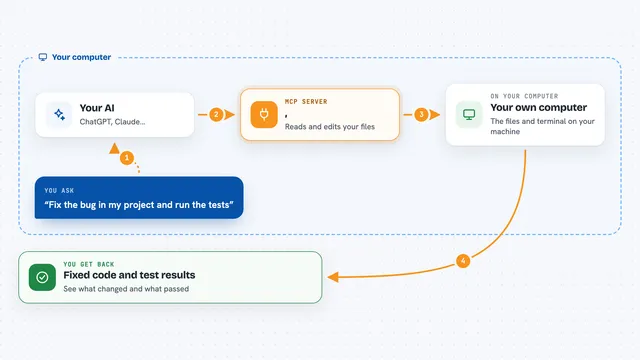
On its own, your AI can only chat with you. An MCP server is a small helper program that gives your AI a new skill or a connection to another service. This one connects your AI to GLM, a coding model from Zhipu and Z.ai. Once it is set up, your AI can ask GLM to do a coding task for you, then show you what GLM did.
What this MCP server does
You ask your main AI assistant to do some coding work. Instead of doing it all itself, the assistant hands the job to GLM through this helper. GLM then reads your files, makes changes, and can run commands in your project folder. When it is done, GLM sends back a short summary and a small stats block showing which model ran, how many tokens were used, and the estimated cost. Your main assistant then reviews the changes and shows you the result.
 Click to zoom
What you can do with it
- Hand a coding task to GLM and get a summary back
- Preview changes as a diff before anything is written
- Undo a GLM run with a git revert line it prints
- See which model ran and how many tokens it used
- Check your total GLM usage and estimated cost
- Ask which engine should handle a task, GLM or your main model
- Run GLM on your project files without leaving your AI chat
Try asking your AI
- “Use GLM to add input validation to the signup form and show me the diff first”
- “Delegate this refactor to GLM and tell me how many tokens it used”
- “Should GLM or you handle this task?”
- “Show me my GLM usage so far”
What it gives back to you
You get a short summary of what GLM did, plus a stats block with the model name, tokens used, number of steps, files changed, and an estimated cost compared to your main model. If you asked for a preview, you get a diff and nothing is written. You can also ask for a status report that shows your running totals from a usage log on your computer.
Before you start
What you need
- A GLM Coding Plan key from Z.ai or Zhipu (a kind of password for the service)
- Node.js installed if you use the npx install commands
- One of: Claude Code, GitHub Copilot in VS Code, Codex, or another MCP client
Good to know
GLM can change and run things in your project folder, and its traffic goes to servers in China, so keep secrets and regulated code on your main model and use the dry run option when you are unsure.
Install it with your AI
Add GLM MCP server to your AI, no technical skills needed
You don't install anything by hand. You copy one prompt, paste it into an AI that can work on your computer, and it checks, installs and connects the server for you, asking you when it needs something.
Sign in to get the install prompt
Members get a ready-made prompt that lets the Claude desktop app check GLM MCP server, install it and connect it for them, step by step. You don't need any technical skills: you copy, paste and answer a few questions. Your connected AI can also find and install any of the 4,609 MCP servers here for you.
Who it's for
Developers and technical writers who already use an AI coding assistant daily and want to cut the cost by letting a cheaper model do the heavy lifting.