MCP server · Developer tools
Lockstep MCP server
Your AI remembers your team's coding decisions and warns you when new code may break them.

Lockstep is a shared memory for the decisions your team makes while building software. It keeps track of rules like "use POST /session instead of POST /login" and reminds your AI about them the next time you sit down to work. It is handy for developers and product managers who are tired of explaining the same choice over and over.
What is an MCP server? The 30-second version
On its own, your AI can only chat with you. It does not know what your team decided last week or what another developer changed yesterday. An MCP server is a small helper program that gives your AI a new skill or a connection to a service. Here, it connects your AI to Lockstep, so your AI can look up your team's decisions and brief you before you start coding.
What this MCP server does
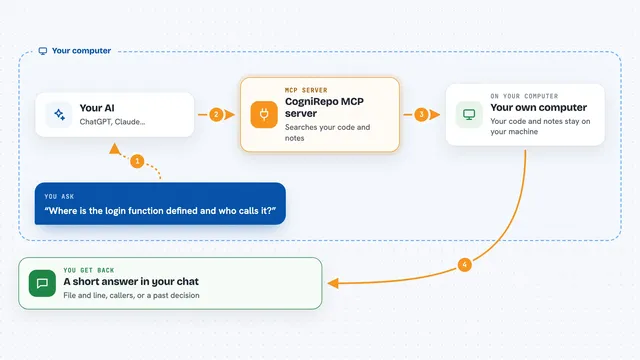
You ask your AI to start working on a task. The AI uses this helper to check Lockstep for any decisions or changes that affect what you are about to do. Lockstep looks at its record of decisions and the connections between services, then sends back the most important ones first. Your AI shows you that briefing in the chat, so you know what rules apply before you write a line. When you make a new decision, the AI can log it so the next person or session sees it too.
 Click to zoom
What you can do with it
- Get a briefing of decisions and changes since your last session
- Log a new decision so your team's AI sessions remember it
- Check whether changed code may contradict an accepted decision
- Ask which services use a particular endpoint or route
- See decisions ranked by how many services they affect
- Copy a decision brief as Markdown to share with a colleague
- Review proposed decisions before they become accepted
Try asking your AI
- “Brief me on any decisions or changes since my last session”
- “Does anyone use the GET /orders/:id endpoint?”
- “Log a decision that exports expire after 24 hours”
- “Check my current changes against our accepted decisions”
What it gives back to you
You get a short briefing in the chat, usually a list of decisions and changes with the most impactful ones first. Each item shows what changed, which service it affects, and how much it matters. If you asked a question like who uses an endpoint, you get a direct answer from the graph. If you logged a decision, you get a confirmation that it was recorded.
Before you start
What you need
- Node.js 20 or newer
- A GitHub account
- Claude Code
- A Git repository with an origin remote
Good to know
It can record decisions and run checks on your code, so review what it proposes before accepting, and remember that checks are advisory and do not block your work.
Install it with your AI
Add Lockstep MCP server to your AI, no technical skills needed
You don't install anything by hand. You copy one prompt, paste it into an AI that can work on your computer, and it checks, installs and connects the server for you, asking you when it needs something.
Sign in to get the install prompt
Members get a ready-made prompt that lets the Claude desktop app check Lockstep MCP server, install it and connect it for them, step by step. You don't need any technical skills: you copy, paste and answer a few questions. Your connected AI can also find and install any of the 4,609 MCP servers here for you.
Who it's for
Developers and product managers who work with AI coding agents and want their team's decisions to stay consistent across sessions.