MCP server · Notes
MCP Memory server
Give your AI a memory that fades over time, so old one-off questions stop haunting every chat.

This is a small helper that gives your AI a memory. Unlike the usual kind, this memory fades: things you mention once slowly disappear, things you keep coming back to stick around. It is handy if you are tired of your AI bringing up something you asked about two months ago as if it were your life's passion.
What is an MCP server? The 30-second version
On its own, your AI can only chat. It forgets everything the moment you close the window, or it remembers too much and drags old stuff into every answer. An MCP server is a small helper program that gives your AI a new skill. This one gives it a memory that lives on your computer, so the AI can save things you tell it and look them up later when they are actually relevant.
What this MCP server does
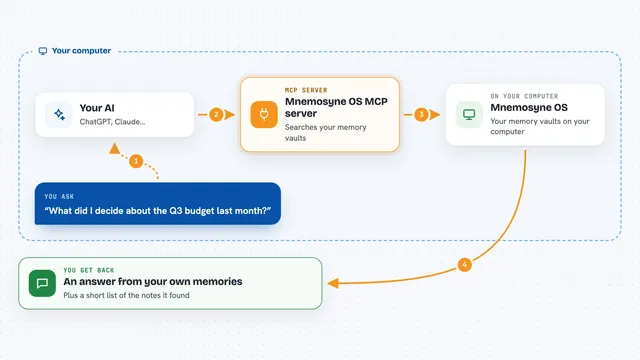
You tell your AI something worth remembering, like a preference or a fact about your work. The AI passes that to this helper, which saves it in a small database file on your machine. The helper decides on its own what kind of memory it is: a quick question, a real interest, a preference, or a fact. Each kind fades at a different speed. When you ask something later, the helper looks through the saved memories, brings back the ones that still matter, and quietly lets the faded ones go.
 Click to zoom
What you can do with it
- Save a preference or fact so your AI remembers it next time
- Ask your AI what it remembers about a topic
- Delete a memory by name, even if you only remember part of it
- See a full list of saved memories with how fresh or faded each one is
- Let a one-time question fade away on its own instead of coming back forever
- Update a preference when it changes, without ending up with two conflicting ones
Try asking your AI
- “Remember that I prefer dark mode in all my editors”
- “What do you remember about the projects I am working on?”
- “Forget anything you have saved about VS Code”
- “Show me everything you currently remember about me”
What it gives back to you
You get answers in the chat, not files. When you ask it to remember something, it usually just confirms it saved it. When you ask what it remembers, you get a short list of the memories that are still fresh, sometimes with a note about how strong each one is. If you ask for the full picture, it can show every saved memory with a label like active or fading.
Before you start
What you need
- The Claude desktop app or another AI app that supports MCP servers
- Node.js installed on your computer (the free program that runs small helper tools like this one)
Good to know
It saves personal details about you in a file on your computer, so be mindful about what you ask it to remember, and know that anything you save can be read by anyone with access to that machine.
Install it with your AI
Add MCP Memory server to your AI, no technical skills needed
You don't install anything by hand. You copy one prompt, paste it into an AI that can work on your computer, and it checks, installs and connects the server for you, asking you when it needs something.
Sign in to get the install prompt
Members get a ready-made prompt that lets the Claude desktop app check MCP Memory server, install it and connect it for them, step by step. You don't need any technical skills: you copy, paste and answer a few questions. Your connected AI can also find and install any of the 4,066 MCP servers here for you.
Who it's for
Anyone who chats with an AI regularly and is tired of it treating every passing question as a permanent fact about them.