
AI news ·
AFL-CIO urged to commit $100 million annually to organize Amazon workers as AI surveillance expands
Amazon uses AI to monitor, discipline, and fire 1.5 million workers across its logistics network. The model is spreading to other industries, creating legal and ethical risks HR leaders should prepare for.
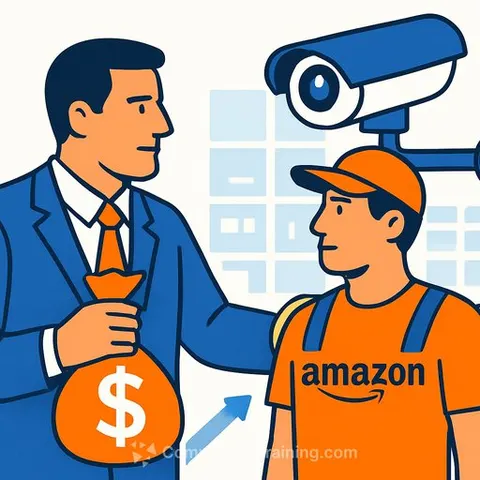
Amazon Uses AI to Monitor and Control Workers. HR Leaders Need to Understand the Implications
Amazon has deployed artificial intelligence systems to track, evaluate, and discipline workers across its logistics network with a level of surveillance that extends beyond traditional management oversight. The company's approach is spreading to other industries, raising questions about labor practices and worker protections that HR professionals should understand.
The scale is significant: Amazon employs 1.5 million workers and contractors. The company operates over 1 million robots in warehouses and subjects delivery drivers to continuous AI-powered monitoring through cameras and algorithmic performance evaluation. Workers report being fired by AI systems rather than human managers.
How Amazon's AI Surveillance Works
Delivery drivers operate under constant monitoring through Netradyne Driver*i cameras installed in Amazon vehicles. The system tracks vehicle speed, stopping behavior, lane positioning, eye movement, and even yawning. AI algorithms evaluate this data in real time and compare driver performance against Amazon's algorithmic standards.
Warehouse workers face similar systems. Amazon tracks pick rates, pack rates, sort rates, and what the company calls "time off task" - including bathroom breaks. Workers who fail to meet algorithmic standards face a progression: counseling, discipline, then termination.
In some warehouses, Amazon employs security officers and local police to enforce what researchers describe as a "near-carceral" workplace culture. Workers have compared the environment to prison.
The Business Model Spreading
Employers across multiple sectors are adopting Amazon's labor model. Factories, grocery stores, hospitals, restaurants, hotels, construction sites, and offices are implementing similar surveillance and algorithmic management systems.
Amazon's approach combines three elements: contracting out workers to avoid direct employment liability, lean staffing that cuts hours unpredictably, and AI systems that monitor behavior and enforce productivity standards. The result is a workplace where technology, not people, makes decisions about worker discipline and employment.
What This Means for HR Leaders
HR professionals should recognize that Amazon's model represents a significant shift in how companies manage labor. The use of AI to replace human judgment in performance evaluation, discipline, and termination decisions creates legal, ethical, and operational risks.
When AI systems make employment decisions, companies face potential liability under employment law. Algorithmic bias can embed discrimination into hiring, evaluation, and termination processes. Workers have fewer opportunities to explain circumstances or appeal decisions made by systems rather than people.
There are also practical workforce risks. Continuous surveillance and algorithmic discipline can increase turnover, reduce employee engagement, and damage employer reputation. Amazon's serious injury rate in warehouses is nearly double the industry average, suggesting that speed-focused management creates safety problems.
The Organizing Response
Labor organizers are attempting to build union representation at Amazon, with limited success so far. The Amazon Labor Union won a representation vote at the JFK8 warehouse on Staten Island in 2022, but Amazon has not agreed to recognize the union four years later.
Organizers argue that Amazon's scale and supply chain complexity require coordinated regional campaigns rather than single-site strikes. A report on Amazon organizing strategy calls for at least $100 million annually for a decade-long campaign, compared to the roughly $10 million currently spent on Amazon organizing across all unions.
Broader Implications for Workforce Management
The adoption of AI-driven surveillance and algorithmic management raises questions about how companies should balance operational efficiency with worker autonomy and dignity. HR leaders implementing similar systems should consider whether the approach aligns with stated values around employee development, engagement, and fair treatment.
Regulatory scrutiny is increasing. Some cities are considering legislation to restrict algorithmic management practices. State and local ballot initiatives could establish safety standards, restrict contracting practices, or require direct employment for certain roles.
HR professionals should understand that Amazon's model is not inevitable. Other companies manage productivity and safety without continuous surveillance or algorithmic termination. The choice between surveillance-based management and approaches that maintain human oversight remains a business decision, not a technical requirement.
For HR leaders, understanding how Amazon's AI systems function and the response they're generating helps contextualize broader conversations about AI in the workplace. These systems represent one approach to workforce management - not the only approach or necessarily the most effective one.
Learn more about AI for Human Resources and how organizations are implementing AI in talent management and workforce analytics.