
AI news ·
AI-driven job cuts spread to finance, retail, and manufacturing as companies automate
AI-driven layoffs could eliminate over 330,000 IT jobs this year. These cuts are now spreading across finance, retail, consulting, and manufacturing.
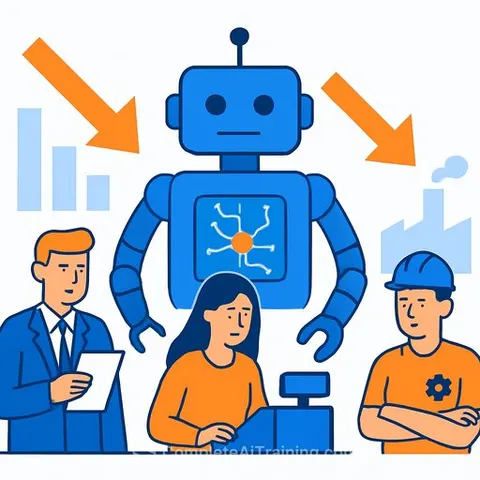
Artificial intelligence-led restructuring is spreading across the global economy, with layoffs now extending far beyond Big Tech into finance, retail, consulting, and manufacturing. Companies are accelerating their use of AI-powered workflow automation and organizational optimization, refining cost-cutting strategies that are expected to expand well beyond a handful of industries.
Meta expands AI-powered content moderation
Meta is accelerating its use of AI to review content and advertisements across its platforms, the Financial Times reported on June 25. The company plans to invest up to $145 billion in AI infrastructure this year, a move widely viewed as being accompanied by aggressive cost-cutting measures to offset its massive AI spending. Meta has already replaced roughly half of its content moderation work with AI and plans to increase that proportion by year-end, generating annual cost savings worth billions of dollars. The company is also considering reducing human review by more than 90% for certain categories of content.
Meta said the expansion of AI-powered content moderation is intended not to reduce costs but to make more effective use of quickly advancing technology. Early trials conducted since March showed that AI made 13% fewer mistakes than human reviewers when identifying policy-violating content while detecting 10% more actual violations. "We deploy advanced AI systems only when they consistently outperform our existing content enforcement methods," the company said.
The broader AI substitution effort comes as Meta CEO Mark Zuckerberg pours hundreds of billions of dollars into talent acquisition and infrastructure in pursuit of developing Personal Super Intelligence. Industry observers conclude the company is simultaneously expanding AI adoption to lower operating costs. Meta has also been aggressively using AI to automate internal functions, including software coding, and has carried out multiple rounds of restructuring. Last month, the company announced plans to eliminate approximately 8,000 jobs, or about 10% of its global workforce.
More than 330,000 IT jobs could disappear this year
AI infrastructure company Cisco announced plans this month to cut approximately 4,000 jobs. Cisco CEO Chuck Robbins said the company had made "difficult decisions" to respond to rapid AI-driven market changes, emphasizing that the restructuring is intended to reallocate resources toward AI, silicon, and cybersecurity rather than simply reduce costs. Microsoft introduced a voluntary early retirement program for the first time in its 51-year history, offering buyouts to roughly 7% of its U.S. workforce, or approximately 8,750 employees.
Oracle reduced its workforce by 21,000 employees over the past year, equivalent to 13% of its total headcount. In its annual report, Oracle acknowledged that the adoption and broader utilization of AI technologies had contributed to workforce reductions and could continue to do so in the future. Software development platform GitLab eliminated 350 positions to support AI infrastructure investment and surging AI workloads, while Intuit announced plans to cut 3,000 jobs as part of an AI-centered organizational restructuring.
Cloudflare has also recently carried out restructuring affecting several thousand employees. Digital asset company Coinbase cut approximately 700 jobs, citing improved AI efficiency, and Snap reduced its workforce by around 16%, pointing to advances in AI as a major factor. Amazon, Dell, Block, and Salesforce have likewise launched large-scale workforce reductions.
Market observers estimate that more than 330,000 workers could be laid off across the global IT industry by the end of this year. Real-time hiring and layoff tracking platforms such as TrueUp estimate that more than 150,000 technology workers have already lost their jobs so far this year, with other estimates suggesting approximately 180,000 workers laid off in just the past six months. That would represent the largest wave of technology layoffs since 2023, when roughly 430,000 jobs were eliminated as companies unwound pandemic-era overhiring.
AI-driven layoffs spread to finance, retail, consulting, and manufacturing
Last month, British banking group Standard Chartered announced plans to eliminate more than 7,000 jobs worldwide by 2030, representing approximately 15% of its 52,000 employees working in corporate functions globally. CEO Bill Winters said the initiative was "a strategic investment to strengthen financial capabilities by replacing low-value-added roles with AI and automation technologies." As AI increasingly handles repetitive data-processing tasks, the bank plans to concentrate more resources on customer service and higher-value financial products.
Citigroup is also continuing workforce reductions as part of a broader organizational efficiency strategy centered on AI. The bank is proceeding with layoffs this year under its previously announced plan to eliminate 20,000 positions while reorganizing its workforce and corporate structure around expanding AI and automation. The company is targeting cost savings of up to $2.5 billion by 2027 through the restructuring.
Retailers are facing a wave of layoffs. Target announced restructuring plans that will eliminate 500 positions in logistics and management while increasing investment in frontline store employees. The reductions include roughly 400 supply chain-related positions and 100 store management roles. Walmart plans to eliminate 1,000 headquarters jobs as it integrates its technology, e-commerce, and advertising organizations, and earlier this year also announced plans to cut 100 jobs at its Hoboken, New Jersey office.
The consulting industry is undergoing similar restructuring. Accenture reduced its workforce by more than 11,000 employees over the past three months as part of its transition toward an AI-centered organization, saying that workers deemed difficult to retrain would be phased out while hiring of AI and data specialists would increase.
Manufacturing is proving no exception. General Motors has eliminated more than 1,000 jobs this year at its flagship Detroit Factory ZERO facility while deploying approximately 50 collaborative robots onto production lines. Nike has also launched a broad restructuring of its manufacturing and technology organizations, deciding to cut an additional 1,400 jobs this year, with combined reductions exceeding 2,000 employees this year alone.
Why this matters for HR professionals
For human resources leaders, the accelerating spread of AI-driven layoffs signals a fundamental shift in workforce planning. Companies are no longer simply cutting costs; they are redesigning operating models around AI capabilities, which means HR teams must manage headcount reductions, the reskilling of remaining employees, and the strategic hiring of AI-related talent. The pattern is clear: as AI automates routine tasks, the demand for human judgment shifts toward higher-value activities, but the transition is often involuntary. HR professionals who understand how to integrate AI into talent strategy while managing the human impact of these changes will be critical to their organizations' success. Resources such as an AI Learning Path for CHROs can help HR executives build the strategic framework needed to lead through this transformation.