
AI news ·
AI layoffs grab headlines but reduced hiring of junior workers may be the bigger threat
Nearly 50,000 U.S. job cuts have been tied to AI so far in 2026, but economists say reduced hiring-especially for junior roles-poses a bigger threat than layoffs.
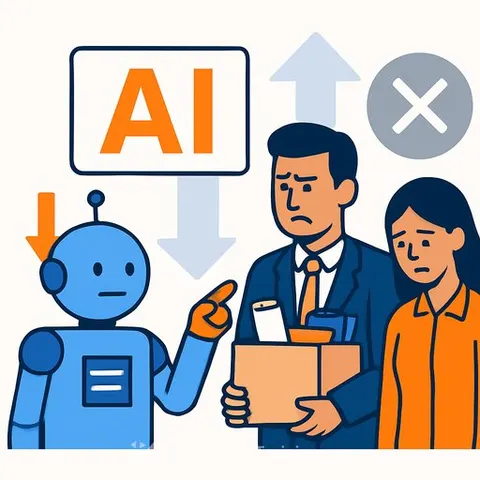
AI Job Cuts Rise, But Weaker Hiring May Hit Harder
Companies have announced nearly 50,000 job cuts linked to AI this year, accounting for roughly 17% of all job cuts announced so far in 2026, according to outplacement firm Challenger, Gray & Christmas. But economists warn that visible layoffs may mask a quieter threat: companies are simply not hiring, especially for junior and entry-level roles.
Intuit cut 17% of its workforce-3,000 people-this week, citing a shift toward AI. Meta laid off 8,000 workers on Wednesday with the same rationale. Cisco announced thousands of cuts last week, with CEO Chuck Robbins saying the company was reducing headcount partly to invest in "employees' use of AI across the company."
Yet most economists say the real labor market impact isn't coming from layoffs. Research from Goldman Sachs shows that in the past year, AI reduced monthly payroll growth by roughly 16,000 jobs, raising the unemployment rate by 0.1 percentage point-a shift driven primarily by reduced hiring rather than mass terminations.
Junior Workers Face the Squeeze
Entry-level and junior positions are easier to automate than senior roles. That means younger workers may struggle to break into the job market even if companies aren't laying off existing staff.
"AI seems to be impacting labor finally, but it's actually not so much through increased layoffs," said Daniel Keum, associate professor of management at Columbia Business School. "The main channel tends to be reduced hiring, especially reduced hiring of junior workers."
Companies are delaying recruitment while they evaluate how AI changes their staffing needs. Unlike layoff announcements, which grab headlines, hiring freezes happen quietly-making the impact harder to measure but potentially more damaging for early-career workers.
Greg Daco, chief economist at EY-Parthenon, cautioned against reading too much into the AI-related layoff announcements. "They are aimed at cutting down on labor expenses, while AI investment is growing very rapidly, but I'm not entirely sure this is a replacement situation where talent is being replaced by technology," he said.
The Messaging Factor
Companies may also be framing workforce cuts as AI strategy for investor relations purposes. Attributing job cuts to AI adoption signals forward-thinking investment to markets, whereas citing weaker demand or rising costs sends a negative message.
"When you announce layoffs in general, it's not seen as a good thing from markets' and investors' perspectives," Daco said. "But when you say you're proceeding with layoffs because of AI, it's positive from a communications standpoint."
Only about 10% of firms currently use AI to produce goods and services, and only a subset are replacing workers with the technology. Boston Consulting Group has projected that up to 15% of U.S. jobs could be eliminated over the next five years, but that timeline remains speculative.
What HR Leaders Should Know
The labor market disruption is real but uneven. Most AI-related job cuts remain concentrated in the high-tech sector. Other industries may face different pressures from geopolitical tensions, tariff policy, and economic uncertainty.
Ken Matos, an organizational psychologist and director of insights at hiring platform HiBob, expects hiring to rebound once companies finish major AI investments. "Right now, companies are moving labor dollars into tech investment," he said. "Hopefully, that moves back into labor dollars once the technology is set up."
Workers who combine AI skills with adaptability may fare best as the market evolves. Matos emphasized personality traits alongside technical knowledge: "We are now looking for the ability to accept risk, people who are motivated by continuous learning, who are engaged by the transformation."
For HR professionals, the immediate challenge is managing recruitment during a period of uncertainty. Understanding AI for Human Resources can help you navigate both the technology adoption and the workforce planning decisions ahead. HR leaders making strategic decisions may benefit from an AI Learning Path for CHROs to understand how AI reshapes talent acquisition, retention, and organizational strategy.