
AI news ·
AI shifts who becomes unemployed in Israel as hi-tech and white-collar workers face rising job losses, Taub Center finds
AI isn't raising overall unemployment, but it's changing who loses jobs, a Taub Center study found. Junior tech workers are hardest hit, with AI driving roughly 20% of the rise in programmer unemployment since mid-2024.
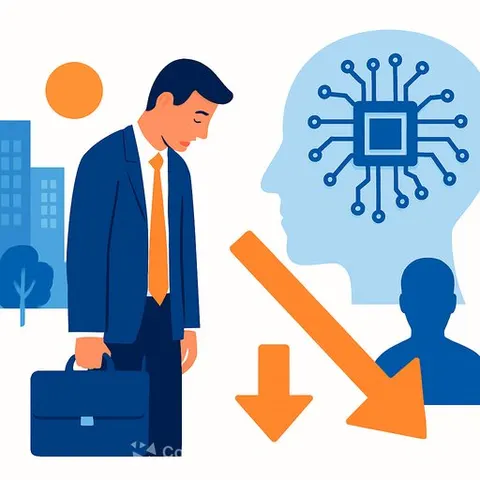
AI Is Reshaping Who Gets Unemployed, Not Overall Jobless Rates
A study by Israel's Taub Center for Social Policy Studies found that artificial intelligence is not yet driving up overall unemployment - but it is fundamentally changing which workers lose their jobs. Researchers discovered that AI explains between 2% and 6% of the shift in occupational distribution of the unemployed between 2022 and 2025.
The impact is concentrated in fields that previously had strong demand and low layoff rates. Software developers, sales representatives, and other tech-adjacent roles are seeing the steepest increases in unemployment relative to their former stability.
Junior Tech Workers Hit Hardest
The research shows a clear pattern: experienced workers are becoming more productive with AI tools, while entry-level positions are disappearing. AI accounts for roughly one-fifth of the increase in programmer unemployment since mid-2024, with junior developers bearing the brunt.
Gil Epstein, head of the labor market policy program at the Taub Center, said: "The era of hi-tech workers' immunity is over. While veteran staffers become more efficient with the help of the machine, the juniors are the first to pay the price."
The researchers documented a 13% decline in employment among young workers aged 22 to 25 in automation-prone occupations in the United States, while experienced workers remained largely unaffected.
Which Jobs Face the Most Risk
Occupations at high risk of AI displacement now account for 20% to 25% of all unemployed workers in Israel, up from 14% to 16% between 2019 and 2022.
Jobs facing significant displacement include:
- Bookkeepers and administrative clerks
- Paralegals and legal assistants
- Market research analysts
- Cashiers and sales representatives
- Warehouse and factory workers
- Drivers (vulnerable to autonomous vehicles)
- Public relations specialists
- Actors and actresses (competing with AI-generated characters)
Blue-collar trades remain largely insulated. Barbers, plumbers, electricians, firefighters, and other hands-on roles show little AI-related displacement because they require direct human interaction.
The Skill Mismatch Problem
The unemployment rise isn't only about jobs disappearing - it's about changing requirements. Even where job openings remain stable, the skills employers demand have shifted, making it harder for displaced workers to transition into available positions.
Avi Weiss, president of the Taub Center, said: "Competition for existing jobs is becoming much tougher, and those who don't adapt their skills to the AI era may find themselves pushed out."
Among telephone sales representatives, AI explains 10% to 26% of unemployment increases. The gap reflects both fewer vacancies and employers' demands for different skill sets.
What Policymakers Should Do
The researchers recommend governments activate support systems for newly unemployed workers and design retraining programs focused on skills that complement AI rather than compete with it.
Weiss added: "The state must already activate assistance systems for the newly unemployed and design programs to provide them with skills complementary to artificial intelligence to enable them to reintegrate into the changing labor market."
Michael Debowy, a researcher on the team, noted that robots have already displaced roughly one-third of traditional manufacturing workers in Israel, though the process moves slower due to implementation costs.
Other Factors at Play
The research team stressed that AI is not the sole driver of these changes. A slowdown in the hi-tech sector, structural shifts from the COVID-19 pandemic, and broader automation trends also contribute to the occupational redistribution of unemployment.
The public sector may be less affected because it responds to political decisions rather than market forces, the researchers said. Teaching positions show no AI-related displacement yet, despite concerns about virtual instruction, partly because Israel faces a severe teacher shortage.
The Path Forward
While overall unemployment remains stable, the composition of the jobless is changing rapidly. Workers who lose positions to AI can often upgrade skills or transition to new occupations if they act quickly.
Debowy said: "Some people will be unemployed, but others will be hired for new professions. Some will benefit, and some will lose. The situation is in flux. There will be a new balance."
For AI for IT & Development professionals and those in AI for Human Resources, understanding these shifts is critical. Workers in exposed occupations who delay skill development risk being left behind in an increasingly competitive labor market.