
AI news ·
Amazon workers struggle with automated HR as company cuts human staff
Amazon laid off tens of thousands of HR workers and replaced them with an AI chatbot. One investigations team shrank from over 100 to 20.
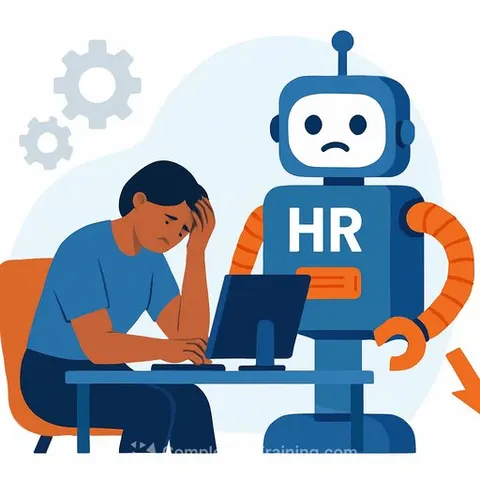
Amazon has been cutting on-site human resources staff across its warehouse network, replacing them with an AI-powered app and chatbot that employees must use for everything from bereavement leave to disability accommodations. The rollout has sparked a surge in complaints, legal claims, and a growing sense among workers and some HR insiders that the company is treating human resources as a system to be automated rather than a function that requires human judgment.
When HR becomes a chatbot
For night-shift workers like Laura at an Amazon warehouse in Ohio, the change is stark. "Now it's like HR is there on banking hours," she said. "On night shifts, we're lucky to see them one day a week." Across warehouses, dedicated HR teams have been whittled down or eliminated, with remaining staff often shared between sites or only available for brief windows.
Amazon's push toward self-service HR accelerated after the company rebranded its HR team as People Experience and Technology (PXT) and laid off tens of thousands of employees across 2023 and 2024. The company said it was trimming middle management to "increase ownership and realize efficiency gains," but interviews and internal documents suggest automation is playing a central role. Workers must now route almost all HR queries through the A to Z app or an AI chatbot called Aza.
The results are frequently described as a loop: the app blocks a request, directs the worker to HR, but the remaining HR staff often send them back to the app. When Laura needed bereavement leave after her cousin died, the app demanded a death certificate she didn't have, stalling the time off. "The app kept blocking it, because I didn't have a death certificate," she said. A medical leave later turned into a month-long ordeal as the system repeatedly requested more paperwork. "The first thing they ask me is if I tried to do it through the app," she said of the rare occasions she finds a live HR person.
Accommodations lost in the system
Workers seeking disability accommodations or medical leave appear especially vulnerable. April Watson suffered a concussion on the job and submitted the required paperwork, but the AI chatbot produced the wrong medical form and her restrictions weren't approved for over a month. While she waited, she was disciplined for performance issues caused by her injury. Former employee Othea Jones, who had a stroke at work, was fired for absences after the app repeatedly denied her accommodation requests. A lawsuit alleged that "the app simply is not designed to allow such an interactive process" required by law.
The Equal Employment Opportunity Commission recently found that Amazon violated the Americans with Disabilities Act by failing to properly implement accommodations. Multiple class-action complaints detail an automated system that parses requests without the kind of back-and-forth dialogue human HR professionals would conduct. Corporate employees are affected as well, according to a separate lawsuit, with claims that the MyHR portal uses AI to approve or deny medical accommodations and that some workers were terminated while awaiting resolution.
HR's own job crisis
Veteran HR employee Susan, who spent 15 years at Amazon, said leadership had been explicit about the end goal. "We were told when we started projects, 'Here's the end game: We want to remove site HR as much as possible. We want everything to be self-service-because it's just not scalable to hire as many people as they were hiring for each of the warehouses.'" By the time she left, her investigations team had shrunk from over 100 people to closer to 20, and AI tools made her so productive she could complete a 40-hour week's work in a single eight-hour day. "It is scary to see how well it worked," she said. "I actually have spent the last year thinking, 'Are there going to be any HR roles in five years?'"
Courtney Badger, an HR professional laid off in 2024, saw her team's case-closure quota quadruple after automation was introduced. "I watched the 'human' get sucked out of the job in the short amount of time that I was there," she said. The company's stated rationale for her layoff, she added, was that AI made it possible to operate with fewer people.
What this means for HR professionals
Amazon's experience is a large-scale test of what happens when the "H" in HR is stripped out in favor of algorithmic efficiency. Routine transactional work is being automated rapidly, and the roles that remain will increasingly hinge on the ability to handle complex, non-standard situations that AI cannot resolve. As more companies follow Amazon's lead, professionals who want to stay relevant will need to deepen their expertise in compliance, employee relations, and the nuanced judgment no chatbot can replicate.
Training that bridges traditional HR and AI-driven systems is already available. The AI Learning Path for HR Managers offers a structured look at how recruitment, workforce analytics, and talent management are being reshaped-competencies that can help HR leaders steer automation without sacrificing employee welfare.