
AI news ·
Companies rehire employees after realizing AI cannot fully replace humans
Companies are reversing AI layoffs after finding automation can't fully replace human workers. A survey found 55% of leaders who cut jobs for AI later admitted it was a mistake.
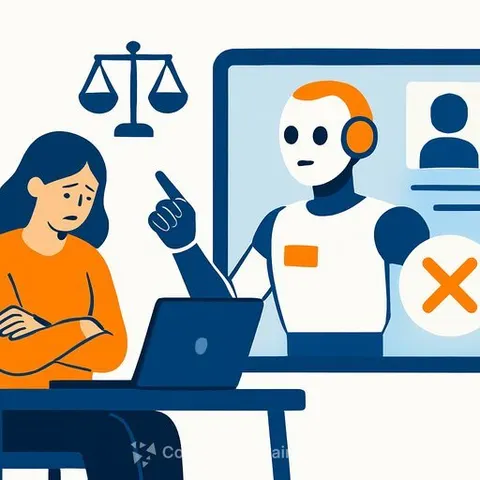
Global companies are reversing AI-driven layoffs and rehiring workers after discovering that automation cannot fully replace human judgment, creativity, and complex problem-solving. The trend, reported by CNBC on July 4, reflects a growing realization that AI's current limits make wholesale workforce reduction a costly gamble.
When automation falls short
Ford re-hired hundreds of experienced engineers after automated systems failed to resolve product quality issues. "Artificial intelligence is a fantastic tool, but only as good as the information you use to train it," said Charles Poon, vice president of vehicle hardware engineering at Ford. The automaker found that experience and domain expertise were still essential to catch what AI missed.
The Commonwealth Bank of Australia replaced dozens of customer service officers with an AI voice bot. Instead of cutting costs, the number of inbound calls rose because the bot could not handle all customer needs. The bank scrapped the layoff plan and brought back human agents to restore service quality.
IBM's human resources division saw a similar pattern. AI handled about 94% of routine HR requests but stumbled on roughly 6% of cases involving complex ethical and decision-making issues. "If we don't continue to invest in hiring entry-level employees, what will happen in the next three to five years? There is no recruitment pipeline; human resources will just dry up," said Nickle LaMoreaux, IBM's head of HR. The company now stresses the need to invest in fresh talent alongside automation.
Surveys reveal a pattern of regret
An Orgvue report found that 39% of business leaders had laid off employees because of AI implementation. Yet 55% of those leaders later admitted the move was a mistake. Separately, a Robert Half survey showed that 32% of U.S. hiring managers eliminated a role due to AI, only to reopen the same or a similar position after the technology did not deliver expected results.
Intuition Labs noted that many companies regret the layoffs because they lost the very people needed to oversee, evaluate, and optimize AI systems. For HR leaders navigating these decisions, AI for Human Resources Courses offer frameworks for integrating technology without gutting the workforce.
Why this matters for Human Resources
HR teams sit at the center of decisions about headcount, automation, and workforce planning. When AI fails to replace humans outright, the burden shifts back to HR to rebuild trust, rehire talent, and design hybrid workflows. ADP APAC Senior Vice President Jessica Zhang said, "If AI results are inconsistent, inaccurate, or difficult to implement, companies often need to reintroduce human oversight."
Rather than treating AI as a full substitute for labor, HR professionals can position it as a productivity tool that still requires human stewardship. Practical training-such as AI for HR Managers Courses-helps HR leaders develop recruitment automation strategies and workforce analytics that account for AI's real-world limitations. The lesson from Ford, CBA, and IBM is that over-reliance on automation creates hidden costs that skilled HR judgment can prevent.