
AI news ·
Digital twins of employees raise unresolved questions on ownership, liability and pay
HR digital twins - AI models trained on an employee's meetings, documents, and work style - are moving from pilot to standard practice. But questions around consent, data ownership, and liability remain largely unanswered.
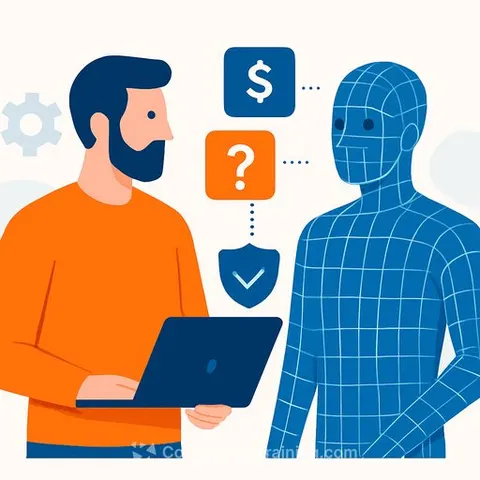
Digital Twins Are Coming to HR. Organizations Aren't Ready for the Legal and Ethical Questions.
Bloor Research now offers every new employee a digital twin. Richard Skellett, the firm's chief analyst, built the first one three years ago by feeding ChatGPT his meetings, research, presentations, and problem-solving approach. The result: Digital Richard answers questions on his behalf around the clock, analyzes policy and workforce trends, and works at what Skellett describes as 100 times his speed.
One analyst used their digital twin to manage a phased retirement. Another's covered maternity leave without hiring temporary staff. The technology has become standard at the firm, signaling what Gartner identified as one of 2026's top future of work trends.
But as organizations begin piloting and deploying these systems, they're not asking the hard questions first. Eighty percent of HR leaders surveyed by Gartner plan to deploy agentic AI within the next year, with digital twins as the next step. The foundational decisions about governance, consent, compensation, and data rights need to happen now, before the technology arrives at scale and employment tribunals are left to set precedent.
What Is a Digital Twin?
A digital twin is a language model trained on an individual's meetings, calls, documents, and presentations, refined to replicate how that person thinks and solves problems. Advanced versions include computer-generated voice and visual likeness.
The immediate use cases are practical. Knowledge management tops the list: a twin trained on a retiring expert's work gives new hires access to that person's experience long after they leave. Executives use twins to scale their presence without multiplying their hours. At the individual level, a twin handling routine email frees the human for higher-value work.
Skellett frames it as a value proposition shift. "Now you can hire the Digital Richard and the Human Richard together," he said, "and the value proposition is much stronger."
Accountability Becomes Murky Fast
The thorniest question is accountability. If a digital twin gives wrong advice to a client, produces output its human counterpart would never authorize, or simply gets something wrong, who's liable?
Anjali Malik, an associate at UK employment law firm Bellevue Law specializing in employment disputes, sees this clearly. "In most cases, the answer will be the employer," she said. "If the AI is operating within the business and its outputs are being relied on, it will be treated much like any other tool or employee acting in the course of employment. Employers shouldn't assume AI diffuses responsibility. If anything, it concentrates it."
California's AB 2602, which took effect in January 2025, requires clear consent before employers can use AI-generated replicas of workers' voices or visual likenesses. It remains the only state to have done so, and no federal framework exists.
Malik's advice to employers is not to wait for legislation. "Employers should be carrying out proper data protection impact assessments, being transparent with staff, and tightly defining how these systems are used," she said. "This is as much a governance issue as a legal one."
Who Owns the Twin-and Who Gets Paid?
Skellett's position is unambiguous: the twin belongs to the individual. "Your employer's renting you," he said. "So if you decide to leave, why can't they just rent the digital version of you?" His company pays employees based on outcomes rather than time, which means a twin generating commercial value earns its owner more.
Kaelyn Lowmaster, a senior principal on Gartner's future of work research team, sees compensation differently but recognizes the same principle. "There's potentially a chance to look at this in terms of royalties," she said. "If you're using my name and my image and my thought work, maybe you could think of a model, kind of like name, image, and likeness for college athletes in the US, where you could compensate people for the way that you're using their name, their likeness, their voice."
She emphasized this should be an opportunity for fairer compensation, not a justification for extracting more productivity for less pay.
The Promotion Problem
One emerging application warrants scrutiny: using a digital twin to simulate how an employee might perform under pressure as part of a promotion decision. Leadership could watch how the replica responds to high-stakes scenarios and shape promotion decisions partly on what the software produced.
Lowmaster hasn't yet seen this happen in practice, but she's clear on the risk. "Basing promotion on anything other than an employee's personal performance on the metrics that you've said matter is going to be problematic," she said. "You want to make sure that employees are actually the ones you're evaluating, not an extrapolation of them that they may or may not have had any control over."
Malik sees additional legal danger. "If you're using a digital twin to simulate how someone might perform under pressure, you're edging into automated profiling," she said. "Legally, that raises issues around meaningful human involvement and discrimination law if the model bakes in bias. But even aside from legality, there's a deeper concern about validity. These systems can give an illusion of precision. The risk is that you end up making consequential career decisions based on a model that reflects historic patterns rather than future potential."
It's also the point where a digital twin edges close to a deepfake. "That kind of misrepresentation of actual humans is a danger," Lowmaster said. "My digital twin is doing something that I would never do. So yeah, it's a fine line."
Three Decisions Can't Wait
Most organizations are still a couple of years away from widespread deployment. But the decisions that shape how the technology plays out need to happen now.
Lowmaster identifies three priorities:
- Get clear on governance. What can a digital twin do autonomously? What requires human sign-off? What's it never permitted to do?
- Work through employee data rights and compensation. How should compensation structures evolve if a twin generates commercial value?
- Be transparent with employees. Explain what these systems are actually for. "No one's going to engage with the digital twin if they think it's meant to replace them," Lowmaster said. "Your people are still your people. These technologies are still the technologies they are using. They're meant to build on, expand, scale the expertise of your people, not replace them."
Skellett thinks HR functions that haven't started thinking about this are already behind. "AI doesn't change what HR does," he said. "AI is changing the system in which HR operates."
For more on how AI is reshaping HR strategy and operations, see AI for Human Resources or AI for CHROs (Chief Human Resources Officers).