
AI news ·
German HR teams struggle to keep pace as AI delivers 34% productivity jump
Firms embedding AI in HR saw a 34% productivity jump since 2018, yet only 21% of German employees feel adequately trained to use these tools.
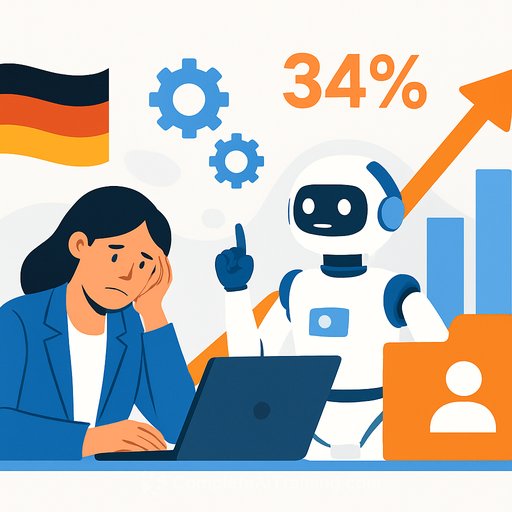
Companies embedding AI into human resources have recorded a 34% productivity jump since 2018, compared to just 24% at less AI-focused firms, according to the PwC Global AI Jobs Barometer 2026. Yet only 21% of German employees report feeling adequately trained to use these tools-a gap that puts the efficiency gains at risk as routine tasks like payroll processing and candidate screening move to machines.
The productivity lift is real, but it concentrates on operational work. Strategic decisions and domain expertise remain inside the organization. Executives at thyssenkrupp, during the industrial group's shift to a financial holding structure, warned that outsourcing core HR strategy is off the table. External specialists may be brought in for niche areas such as capital-market know-how or AI consulting, but the strategic helm must stay internal.
AI-generated résumés are slowing down hiring
The technology that speeds up back-office work is creating friction in recruitment. A Robert Half study found that AI-generated résumés are slowing the hiring process for most HR leaders in North America. The tools can exaggerate or fabricate professional experience, forcing hiring managers to apply more human judgment. As a countermeasure, companies are shifting toward skills-based hiring and moving away from formal educational credentials. Platforms like AQIIDO HR and Fusemachines support this trend with AI-powered analysis of labor-market and applicant data.
This shift in hiring philosophy comes as HR teams also confront a wave of AI for HR Courses and training demands. Bridging the gap between tool adoption and workforce capability is now a central challenge for people leaders.
Pay transparency lags despite EU rules
While technology reshapes parts of HR, traditional administrative roles hold firm. The city of Stuttgart is currently recruiting payroll accounting and tax compliance specialists, demanding deep expertise in company pension schemes, garnishment law, and wage tax.
Pay transparency, however, remains patchy. An Index-Research analysis for the first quarter of 2026 found that only 23% of German job advertisements include concrete salary figures. The rate drops to 14% in marketing and PR. Germany's federal government let the implementation deadline for the EU Pay Transparency Directive pass on June 7, 2026, meaning mandatory salary disclosure in job ads is not yet widespread.
SAP migration forces a strategic rethink
A major driver of HR role transformation is the migration of legacy IT systems. Maintenance of SAP HCM is guaranteed only until the end of 2027, with an optional extension to 2030. Companies must manage the transition to cloud solutions such as SuccessFactors. Payroll modules do not automatically move to the cloud-this demands a separate strategic plan for payroll architecture.
This technical overhaul coincides with heavy workforce reductions across core industries. Ford cut around 3,500 positions in Cologne in June 2026, citing weak demand for electric vehicles. Chemical giant Evonik plans an additional 3,200 job cuts between 2027 and 2029, on top of 2,800 already planned by the end of 2026.
New leadership for turbulent times
HR leadership roles are being filled with change specialists. Nadine Henseler has taken over as People Director at Carglass Germany, responsible for roughly 2,400 employees and reporting directly to the board. Her mandate is to steer the workforce through phases of transformation and structural change.
For senior HR leaders navigating this mix of AI adoption, regulatory gaps, and system migration, structured AI Learning Path for CHROs can provide a framework for building the strategic oversight these shifts demand.
Why this matters for HR professionals
The 34% productivity number is not just a benchmark-it is a warning. When only one in five employees feels trained on AI tools, the productivity gains sit on fragile ground. HR teams are now the gatekeepers for both adoption and risk: they must filter out AI-fabricated résumés, prepare for payroll architecture decisions tied to SAP deadlines, and operate in a regulatory environment where pay transparency rules are in flux. The role is shifting from administrator to strategic operator, and the organizations that treat it as such will be the ones that actually hold onto the 34% gain.