
AI news ·
HII and Applied Intuition sign MOU to integrate AI operating system into naval vessels
HII and Applied Intuition signed a deal April 21 to integrate Applied Intuition's Warship OS across HII's naval platforms. The software links navigation, weapons, and sensors under one AI layer, starting with HII's ROMULUS unmanned surface vessels.
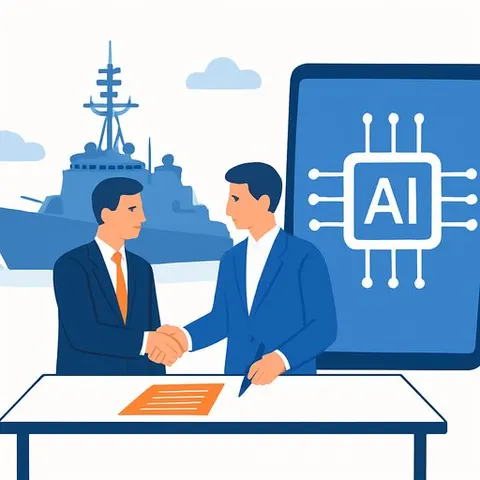
HII and Applied Intuition Partner on AI Operating System for Naval Vessels
HII and Applied Intuition signed a memorandum of understanding on April 21 at the Sea-Air-Space Exposition in National Harbor, Maryland, to develop AI-defined operating capabilities for next-generation warships. The partnership centers on integrating Applied Intuition's Warship OS-software designed to connect data and AI systems across an entire ship-into HII's unmanned and crewed naval platforms.
The collaboration addresses a practical problem: naval systems currently operate in silos, with separate software controlling navigation, weapons, sensors, and other functions. Warship OS aims to unify these systems under a single AI-defined operating layer, allowing ships to adapt mission capabilities in real time without redesigning hardware.
Initial Focus: Unmanned Vessels
HII and Applied Intuition will first integrate Warship OS into HII's ROMULUS family of unmanned surface vessels currently under construction at Breaux Brothers shipyard in Louisiana. ROMULUS platforms handle intelligence, surveillance, and reconnaissance missions, mine countermeasures, and launch operations for smaller drones.
The companies plan to reduce the engineering burden of integrating autonomy and navigation systems by consolidating them under Warship OS. This approach allows coordinated behavior across multiple ship systems without custom engineering for each vessel.
Expansion to Crewed Ships
After validating the software on unmanned vessels, HII and Applied Intuition will explore extending Warship OS to crewed combat ships. HII's Ingalls Shipbuilding division will lead design work aligned with Navy requirements, focusing on open architecture and the ability to insert new capabilities without full system redesigns.
The companies will also test Warship OS integration on HII's REMUS unmanned underwater vehicles.
Why This Matters for Defense Technology Teams
The partnership reflects a shift in how defense contractors approach naval modernization. Rather than building custom software for each ship class, HII and Applied Intuition are treating the operating system as a standardized foundation-similar to how Linux or Windows function in commercial computing.
This approach reduces development cycles and allows operators to deploy new sensors, weapons, or autonomous behaviors through software updates rather than hardware modifications. For government acquisition teams, it means faster capability delivery and lower integration costs.
Eric Chewning, HII's executive vice president of maritime systems and corporate strategy, said the partnership "accelerates the development of AI-defined warships that can adapt to rapidly evolving mission needs." Peter Ludwig, Applied Intuition's co-founder and CTO, added that the software allows "operators the flexibility to adapt to evolving mission needs in real time."
HII is the nation's largest military shipbuilder and produces autonomous surface and underwater vehicles. Applied Intuition, valued at $15 billion, provides AI infrastructure for autonomous systems across automotive, defense, trucking, and other industries.