
AI news ·
HR leaders call for stronger governance and human oversight in agentic AI deployment
HR is redesigning governance as agentic AI independently executes workflows. Companies must retain ultimate accountability for AI-led decisions through human oversight.
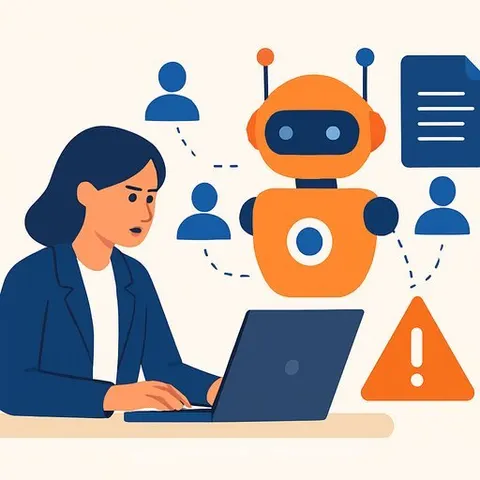
As companies deploy agentic AI systems capable of independently executing tasks and making recommendations, human resources leaders are redesigning governance frameworks and workforce strategies. This shift requires HR to determine how humans and machines will share responsibility, moving beyond simple technology adoption to fundamental workforce transformation.
The shift to agentic systems
Agentic AI represents the next phase of enterprise deployment. Unlike traditional automation that follows predefined instructions, agentic systems trigger workflows, analyze outcomes, and initiate subsequent actions with limited supervision. R Systems CHRO Satyadeep Mishra explained the practical advantage of this capability. "What agentic AI brings to the table is the ability to orchestrate the right outcome for the organisation, provided the right context engineering has been done," he said.
Human oversight in critical decisions
The growing capability of these systems is prompting organizations to revisit the role of human judgment in people decisions. While AI can assist with workforce planning and recruitment, executives maintain that trust, empathy, and ethical decision-making remain outside the scope of machine intelligence. Radhika Arora, CHRO at Isgec Heavy Engineering, noted that situations involving organizational culture and employee conflicts continue to require human involvement.
She cited recent labor unrest across industrial project sites as an example requiring on-ground intervention rather than algorithmic decision-making. "No amount of AI can build that trust in the organisation. In a crisis-like situation, no amount of AI can help. A high-potential employee is struggling with a personal situation. He needs a genuine human connection," Arora said.
Accountability and governance
Questions around responsibility for AI-led decisions are becoming urgent as organizations deploy advanced systems across people functions. Executives argue that accountability cannot be transferred to technology vendors or algorithms. Meenakshi Cornelius, Head of HR at JLL India, pointed out that flawed datasets and historical biases can easily be replicated when embedded into automated systems.
"The accountability lies with what goes inside. The organisation always, in any scenario, is responsible overall," Cornelius said. She added that HR leaders must scrutinize data inputs and establish governance mechanisms rather than accepting machine outputs at face value. Implementing strict governance is a core component of effective AI for Human Resources, ensuring transparency around how algorithms influence decisions.
The transition is forcing HR departments to reconsider their operating models. Functions historically focused on administration are increasingly expected to drive business outcomes. Saurabh Deep Singla, Chief People Officer at Hexalog Technologies, said HR leaders should focus on integrating AI into business processes rather than attempting to become technology specialists.
"HR doesn't need to become a coder. HR really knows how to understand the business and decode and put that whole thing into the people understanding and create sense out of it," Singla said. Pursuing a dedicated AI Learning Path for CHROs can provide executives with the strategic frameworks needed to connect workforce decisions with business performance.
Why this matters for Human Resources
HR professionals must treat AI deployment as a workforce transformation initiative, not just an IT project. The core challenge is ensuring that autonomous systems strengthen business outcomes while preserving trust, accountability, and human judgment. Leaders who fail to establish clear governance and human oversight risk amplifying historical biases and losing employee trust during critical organizational moments.