
AI news ·
HR leaders split on how to handle AI use by candidates in job interviews
AI tools now feed real-time answers to job candidates during live interviews, undetected by recruiters. Over 72% of hiring leaders have moved some interviews in-person to counter it.
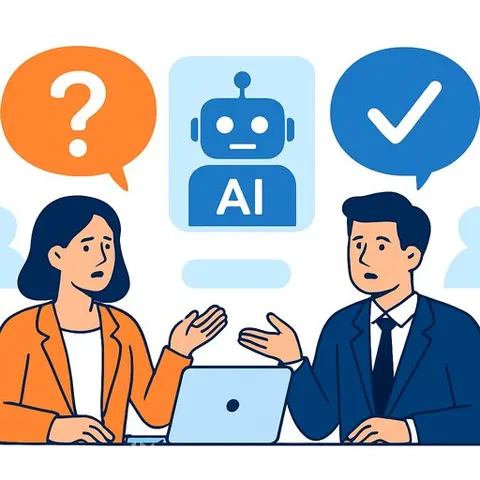
AI Co-Pilots in Job Interviews Are Forcing HR Teams to Rethink How They Hire
Candidates appearing composed and articulate in remote interviews may have invisible help. AI tools like Final Round AI and Interview Copilot feed real-time answers to job seekers during live hiring conversations - prompts the interviewer never sees. The problem has grown widespread enough that over 72% of recruiting leaders now conduct some interviews in person specifically to counter it.
Shawn Gibson, Chief People Officer at Info-Tech Research Group, encountered this firsthand. "What we're finding is that sometimes we get a sense that candidates are using AI right in the actual interview with the recruiter," he said. "And that's just not acceptable. It's not evaluating the candidate properly."
The mechanics are simple
An AI tool receives the interview question and immediately generates an answer. The candidate reads it aloud while the recruiter remains unaware anything unusual is happening.
For distributed organizations, the problem compounds. Info-Tech operates across six countries with recruiters based in North America, making it difficult to detect AI assistance when hiring in places like Singapore. Gibson proposed one workaround: a hybrid model where a senior leader meets candidates in person while a recruiter joins virtually. That physical presence can catch behavioral cues a screen cannot.
Christine Vigna, Chief People Officer at Dejero, said experienced hiring managers spot the pattern. "There are long pauses. They will give an extremely well-articulated answer - and then you ask the next question, there's a pause and then they go again," she said.
The hypocrisy question
Vigna raised a counterpoint: employers themselves use AI extensively in hiring. Resume screening tools, candidate response evaluators, and automated scoring systems are now standard. "So many employers are now using AI in the hiring process themselves," she said. "It's a tad hypocritical that employers can use AI for all of their processes, and yet we're saying that employees should not be using AI in that hiring process."
This logic is shifting how some companies evaluate candidates. Rather than disqualifying applicants who use AI, Dejero digs deeper afterward. The company asks candidates about their prompts, how they used the tools, and what they might improve. This tests both AI fluency and underlying knowledge - skills increasingly relevant to actual job performance.
"If we have candidates who are comfortable using AI, it's a bonus," Vigna said.
AI screening AI
Gibson flagged a broader tension: "Candidates are applying with AI, but then recruiters are using AI to look at it. So, you literally have AI to AI issues being created."
Recent data underscores the scale. A survey found that 22% of job seekers admit to using AI during live interviews - a figure HR consultant Bryan Driscoll suggested is likely much higher. Separately, 70% of candidates were never informed that AI would evaluate them during the hiring process.
Both Gibson and Vigna stressed the same principle: governance must precede adoption. "The pace of adoption gets ahead of the governance around it," Gibson said. Info-Tech paused a planned AI-powered HR assistant when it recognized privacy guardrails needed closer attention first.
What HR leaders should do
Vigna recommends treating AI literacy as a measurable competency, not a disqualifier. Build interview structures that require candidates to demonstrate reasoning, not just output. Ask them to walk you through how they used a tool and probe for the thinking behind answers.
Gibson's advice is structural: reconsider whether remote-only hiring still serves your needs. Where can human presence - virtual or in person - restore judgment that AI obscures? "Where can we have employees interject? Where do we really need human scrutiny, human touch?" he said.
Vigna concluded: "There needs to be a world in which our hiring practices are thoughtful and inclusive about the fact that candidates are using AI." Organizations that get there first won't just find better hires. They'll build the kind of candidate trust that a purely algorithmic process never can.
For HR teams navigating these shifts, resources like AI for Human Resources and the AI Learning Path for CHROs offer structured guidance on implementing AI responsibly across recruitment and talent management.