
AI news ·
HR leaders shift hiring toward mid-level workers as AI takes over junior tasks, risking future leadership shortage
30% of U.S. HR leaders are cutting entry-level hiring and using AI to cover tasks once given to junior staff. Half warn this will cause a senior leadership shortage within five years.
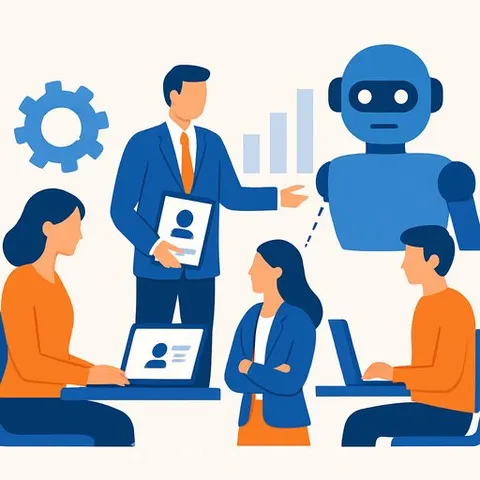
AI Is Shrinking Entry-Level Hiring, Creating a Leadership Crisis Within Five Years
Three in 10 HR leaders in the U.S. are shifting their talent acquisition strategy toward mid-level hires, using AI to handle tasks that previously went to junior staff. A survey of 546 HR leaders found that 30% are moving away from entry-level hiring in favor of this approach.
The data suggests this trend is still emerging. Currently, 64% of HR leaders expect entry-level hiring to increase over the next 24 months, while only 12% project a decrease. Among those expecting declines, 56% cite AI-driven automation as the primary reason.
The Problem: Junior Staff Aren't Learning Anymore
AI is changing how senior staff delegate work. According to the survey, 56% of HR leaders say AI has reduced the need to assign basic research, writing, data analysis, and administrative tasks to junior associates. This matters because these routine tasks traditionally taught new graduates how to think critically and build expertise.
The research describes this as "hollowing out" the traditional proving ground. When AI completes foundational work instead of junior employees, those employees shift from being creators of information to consumers of it. They miss the cognitive struggle that builds deep knowledge.
HR leaders are already seeing the fallout. Compared to three to five years ago, skills gaps among recent entry-level hires have worsened significantly: 75% report worse problem-solving skills, 76% cite weaker interpersonal skills, and 78% note communication deficits.
The Five-Year Forecast: A Leadership Shortage
Half of HR leaders who expect entry-level hiring to decline due to AI agree the reduction "will create a shortage of qualified senior leaders in our organisation within five years." Despite this concern, 77% of HR leaders say they are confident their organization can develop future strategic leaders.
The contradiction reveals the scale of the problem. Organizations are optimistic about their ability to develop leaders while simultaneously acknowledging they're eliminating the foundational experience those leaders need.
Nearly half of HR leaders envision a future "diamond-shaped" workforce: heavy in mid-level roles but comparatively thin at entry and senior levels if current trends continue.
Upskilling Programs Are Missing
Nearly three-quarters of HR leaders (74%) do not yet have active upskilling or employee development programs to replace the on-the-job learning lost to automation. Formal support structures are falling behind workplace change.
Organizations are gaining short-term efficiency but risking a talent gap. Without intentional learning investment, companies won't grow their own experienced workforce to fill senior roles in five years.
What HR Leaders Should Do Now
The research recommends HR teams develop structured learning programs beyond basic onboarding, create internal apprenticeships and rotational assignments, and use AI-enabled simulations to recreate complex tasks. Hiring should shift toward skills-based approaches that prioritize critical thinking, communication, and AI literacy.
The core finding is straightforward: the job market isn't collapsing, but it's reconfiguring. The cognitive struggle and learning-by-doing that once underpinned entry-level work are being eroded. Without deliberate action, organizations will face a shortage of qualified leaders within five years.
For more on how to address these challenges, explore AI for Human Resources or the AI Learning Path for CHROs.