
AI news ·
Inclusion-focused AI reduces disability bias in hiring decisions, Macquarie study finds
Inclusion-focused AI nearly doubled hiring rates for disabled candidates in complex recruitment scenarios, a Macquarie Business School study found. Standard efficiency-focused AI showed no such effect.
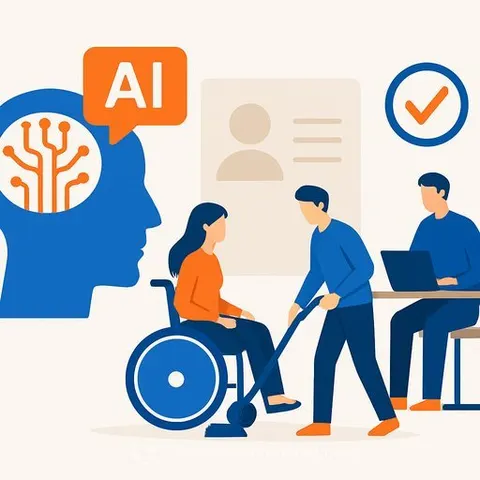
Study: Inclusion-Focused AI Can Reduce Disability Bias in Hiring
Researchers at Macquarie Business School found that generative AI designed to prompt fairness considerations significantly increased the likelihood of hiring candidates with disabilities in complex recruitment scenarios. Standard AI tools focused solely on efficiency did not produce the same effect.
The study, published in Human Resource Management Journal, examined how 238 HR professionals made hiring decisions under varying levels of complexity. In complex scenarios, disabled candidates were selected 34 percent of the time-well below a neutral benchmark of 50 percent. When inclusion-focused AI guided evaluators to focus on job-relevant competencies and fairness considerations, selection rates for disabled candidates rose substantially, sometimes nearly doubling.
Why Bias Strengthens Under Pressure
Disability discrimination persists in hiring despite growing awareness of diversity initiatives. The research points to a specific mechanism: when hiring decisions become cognitively demanding, people rely more heavily on mental shortcuts and stereotypes rather than objective data.
In simpler hiring decisions, managers tend to focus on concrete skills and qualifications. As complexity increases, the human brain defaults to "safe" assumptions. That cognitive load is where bias takes hold.
How Inclusion-Focused AI Works Differently
The distinction matters. Not all AI reduces bias equally. Standard AI tools that prioritize speed or technical screening don't address the underlying problem-they can actually reinforce it.
Inclusion-focused generative AI operates differently. Rather than simply filtering resumes, it actively guides decision-makers. It prompts evaluators to examine specific skills and evidence, shifts attention away from abstract assumptions, and keeps focus on individual merit.
The approach draws on Construal Level Theory, which explains how psychological distance shapes decision-making. By prompting concrete details instead of broad generalizations, inclusion-focused AI reduces that distance and interrupts the pattern that allows stereotypes to dominate.
The Calibration Challenge
The research identified one risk: in some scenarios, inclusion-focused AI appeared to overcorrect, producing selection rates for disabled candidates above neutral benchmarks. This raises the possibility of inverted bias, where efforts to reduce discrimination swing too far in the other direction.
This doesn't eliminate the benefits, but it underscores the need for careful implementation.
To genuinely improve fairness, AI tools should:
- Prompt evaluators to focus on job-relevant competencies
- Embed diversity and inclusion principles into decision workflows
- Make reasoning transparent and auditable
- Support rather than replace human judgment
Building Fairness Infrastructure
The most effective approach treats AI as one component of a broader fairness system. Structured interviews, standardized criteria, and accountability processes work alongside AI to support human judgment rather than remove it.
For HR professionals implementing AI-driven recruitment, the takeaway is straightforward: the tool matters less than its design. AI built to guide decision-making toward fairness produces different results than AI built for efficiency alone.
Learn more about AI for Human Resources or explore the AI Learning Path for CHROs to understand how to implement these tools effectively in your organization.