
AI news ·
45,000 Samsung workers plan 18-day strike at the heart of the global AI memory supply chain
45,000 Samsung workers plan to strike May 21 for 18 days, threatening the world's largest chip work stoppage. Samsung makes a third of global DRAM and dominates AI memory supply.
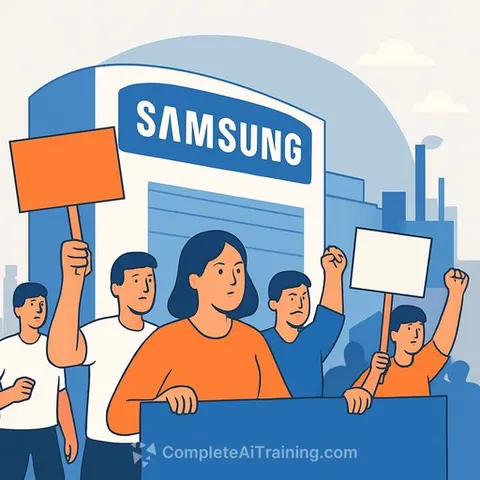
Samsung's 45,000-Worker Strike Could Disrupt AI Supply Chain at Critical Moment
Nearly 45,000 unionized Samsung workers plan to walk off the job on May 21 for 18 days. If the strike happens, it will be the largest work stoppage in semiconductor industry history-and it will hit at the worst possible time for the global AI boom.
Samsung manufactures roughly one-third of the world's DRAM, the memory chips inside phones, laptops, servers, and data centers. With SK Hynix, it controls about two-thirds of the global DRAM market and an even larger share of HBM-the specialized memory that AI systems require to function. Only three companies make HBM at all: Samsung, SK Hynix, and Micron.
The company operates 12 fabrication lines across three South Korean complexes and employs over 260,000 people worldwide. Samsung is investing $73 billion in semiconductor capital expenditure and research this year alone, the largest single-year chip investment by any company in history.
What the Union Wants
Samsung's unions are requesting 15% of annual operating profit be allocated to a bonus pool, removal of the current cap that limits bonuses to 50% of base salary, and a 7% wage increase. Management countered with roughly 13% of operating profit, but only as a one-time payment for 2026 with no permanent structural changes.
The union's demands stem directly from what SK Hynix offered its workers last September. SK Hynix agreed to allocate 10% of annual operating profit to employees as performance bonuses for the next decade, with no bonus caps. Based on 2026 profit forecasts, that translates to average payouts of $460,000-$477,000 per worker across SK Hynix's 35,000 staff, with projections approaching $900,000 per person next year.
Samsung paid no performance bonuses in 2024 after its chip unit posted operating losses throughout the memory downturn. Even as the turnaround has been staggering-Q1 2026 operating profit increased nearly eightfold to a record-workers received none of the payout.
The talent drain is real. Union chairman Choi Seung-ho said roughly 200 Samsung employees have left for SK Hynix over the past four months. The wage gap between the two companies is creating a competitive disadvantage Samsung cannot ignore.
The Economic Impact
An April one-day labor walkout provided a preview of what an extended strike could do. Foundry output dropped 58% and memory fabrication fell 18% during that single shift. Samsung has begun scaling back wafer inputs to prepare for a potential full shutdown, since halting chip fabrication mid-process means scrapping wafers that cost $20,000 each.
Industry estimates put potential losses from an 18-day strike at 30 trillion-100 trillion won (roughly $20 billion-$67 billion). JPMorgan analyst Jay Kwon estimated that if Samsung meets the union's full demands, 2026 operating profit faces a 7%-12% downside from increased labor costs alone. Add more than 4 trillion won in lost revenue from 18 days of reduced production, and the total operating profit impact lands at roughly 2.1 trillion-3.5 trillion won in JPMorgan's base case.
Samsung Chairman Shin Je-yoon said he was "worried about losing market leadership amid fleeing customers and falling competitiveness" in the event of a strike.
Why Timing Matters
Samsung is in the middle of reclaiming ground it lost to SK Hynix. For the first time in 33 years, SK Hynix overtook Samsung as the world's largest DRAM maker in Q1 last year, driven almost entirely by dominance in HBM for AI. In the next quarter, SK Hynix held 62% of the global HBM market as Samsung slipped to 17%, behind even Micron at 21%.
Samsung's turnaround has accelerated. Its HBM4 chips, which began mass production in February, have reportedly outperformed early expectations. The entire 2026 HBM4 production run is already sold out. A prolonged strike could derail this momentum.
The memory market is tight enough that Apple held emergency meetings with Samsung's semiconductor division earlier this year to lock down memory for iPhone 17 production. Samsung reportedly planned to push for a 60% price increase, opened with a demand for 100%, and Apple accepted immediately. That's how constrained supply has become.
Negotiation Status
A 17-hour negotiation session at the National Labor Relations Commission on May 13 failed to produce a deal. The commission initially proposed roughly 40 trillion won ($26.7 billion) in total bonus payouts, which the union rejected. Samsung then sent a letter proposing further direct dialogue, and the union accepted only if co-CEO Jun Young-hyun personally presents concrete proposals on key issues.
No deal has been reached yet. The clock is ticking toward May 21.