
AI news ·
Is AI quietly eroding your critical thinking?
Heavy reliance on chatbots can dull memory and judgment; studies show lower brain activity and poorer recall when we let them think for us. Use AI to stress-test, not substitute.
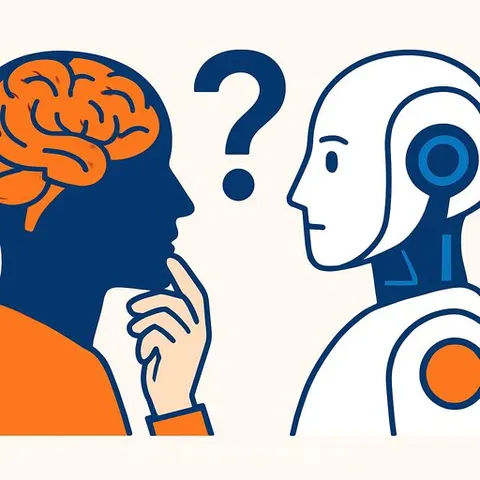
Are these AI prompts damaging your thinking skills?
Asking a chatbot has become the default move for homework, reports, and even cover letters. It's fast and it feels productive. But there's a growing body of research suggesting that heavy reliance on AI can blunt critical thinking and memory-especially when we let it think for us.
Below is what recent studies are signaling, and a practical playbook to keep your brain in charge while still getting the speed benefits of AI.
What AI Research is signaling
MIT researchers split 54 adults into three groups: ChatGPT users, Google search users, and a no-tools group. Participants wrote multiple SAT-style essays while the team recorded brain activity via EEG across 32 sites. The ChatGPT group showed the lowest activity, performed worse across neurological, linguistic, and behavioral measures, and some couldn't recall what they had written. Over months, reliance deepened-several shifted to copy-and-paste outputs.
A Carnegie Mellon-Microsoft study followed 319 office workers using AI on real tasks and tracked how much they doubted, checked, or edited AI outputs. The more people believed "AI is perfect," the less they engaged their own judgment. Novices and less-experienced employees were most susceptible. Short-term productivity rose, but independent problem-solving appeared to decline.
Oxford University Press surveyed about 5,000 UK students. Six in ten felt their study skills had worsened due to AI, yet nine in ten said it had helped at times. Wayne Holmes (UCL) cautioned that AI may boost grades in the short run while undermining learning if students offload the hard parts of thinking. His advice: don't avoid AI-learn its limits and use it with intent.
Why this matters for science, research, and healthcare
- General: Over-trusting AI can shrink your "debug loop"-the habit of questioning assumptions and checking sources.
- Science and research: Offloading literature synthesis and reasoning can hide errors, skew conclusions, and bias experimental design.
- Healthcare: Faster documentation is useful, but unverified suggestions risk clinical shortcuts and anchoring on the wrong answer.
Keep your brain engaged: a simple playbook
- Write first, then ask. Draft your hypothesis, outline, or diagnostic plan before prompting. Even 5 minutes helps.
- Use AI to challenge, not replace. Ask for counterarguments, alternative mechanisms, or opposing diagnoses with pros/cons.
- Force transparency. Require the model to list assumptions, uncertainties, and where an error would most likely occur.
- Demand sources you can check. Ask for citations you can open and scan; sample a few and verify quotes and data.
- Add friction to copy-paste. Summarize in your own words before pasting. If you can't paraphrase it, you don't own it.
- Set a "no-AI" window. For tough tasks, think solo for the first 10-20% of the time. Then use AI to stress-test your approach.
- Compare with a baseline. Solve one version without AI each week to keep your instincts sharp.
- Log decisions. Keep a brief "why I chose this" note. It builds accountability and a trail for auditing AI influence.
- Rotate tools. Don't rely on a single model. Cross-check key outputs with search, guidelines, or a second system.
Prompt patterns that strengthen thinking
- "List 3 plausible alternatives and the strongest evidence for and against each. Note where experts disagree."
- "Show the top assumptions behind this conclusion. For each, give a quick test I can run to verify."
- "Summarize this paper in 5 bullet points, then state 2 limitations and 2 ways it could mislead a practitioner."
- "Propose a plan A and plan B. State a clear condition that would make me switch plans."
Red flags you're over-relying on AI
- You paste outputs without rewriting, verifying, or adding your reasoning.
- You struggle to recall key points minutes after finishing a task.
- Your prompts ask for final answers, not trade-offs, assumptions, or alternatives.
- Feedback loops vanish: fewer questions, fewer sources checked, fewer notes.
Team norms that prevent skill decay
- Keep a human artifact. Require an outline, rationale, or checklist from the author-not the model.
- Verification rules. For any high-stakes claim, cite and spot-check at least two independent sources.
- AI labeling. Mark AI-assisted sections so reviewers know where to probe.
- Mentor novices on skepticism. Teach how models fail: hallucinations, outdated data, and confident guesses.
For clinicians and researchers
- Use AI to format and speed admin, but separate it from clinical judgment. Keep guidelines and primary literature as the source of truth.
- Ask for differential lists, not a single answer. Then verify against trusted references and your patient/context.
- Document your reasoning path. It protects against anchoring on the first AI suggestion.
Bottom line
AI can accelerate work, but thinking is still your job. If you let the model do the heavy lifting of reasoning, your skills dull. Use AI to challenge your ideas, reveal blind spots, and speed the grunt work-while keeping the core decisions, and the learning, in your hands.
Want structured practice that builds AI literacy (without losing your edge)?
- Prompt Engineering
- AI courses by job role (browse the site's course catalog)