
AI news ·
Maryland school districts face fall deadline to set artificial intelligence policies
Maryland's 24 school districts must adopt AI policies by fall, affecting 900,000 students. The state law requires districts to address data privacy, bias, and training.
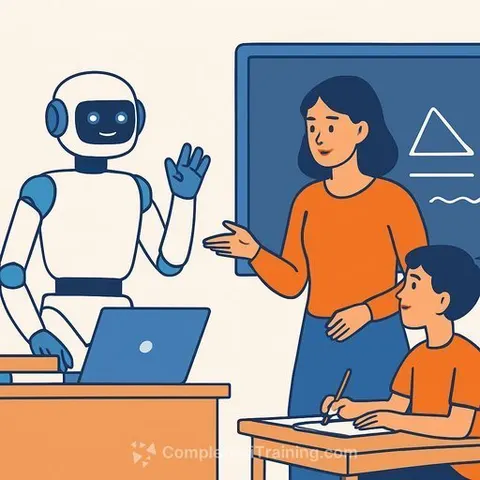
Maryland's 24 public school districts have until this fall to adopt formal artificial intelligence policies, a deadline set by the Artificial Intelligence Ready Schools Act signed by Gov. Wes Moore in May. The law required the Maryland State Department of Education (MSDE) to issue guidance first - the department released its recommendations last month - and gives local systems 120 days from that release to complete their own plans. The timeline marks the first statewide push to embed AI into classrooms with consistent guardrails, affecting how roughly 900,000 students and their teachers will interact with the technology.
What the state guidelines require
MSDE's guidance, developed since fall 2025 with input from superintendents, educators and lawmakers, lists eight elements for districts to address. These include data privacy, technology bias, keeping instruction "human-centered," and clearly defining appropriate AI use. School systems must also follow structured criteria before approving any AI tool and review them continuously for safety and efficacy.
Richard Kincaid, assistant state superintendent for MSDE's Division of College and Career Pathways, said the department will adapt its recommendations as the technology evolves. But he stressed that the teacher's role is not up for negotiation. "AI is not something that replaces the things that are happening within a classroom," Kincaid said. "The teacher will always and forever be the subject matter expert for the content within a class." He described the guidelines as "incredibly clear" on non-negotiables like privacy and bias monitoring, while allowing districts flexibility in choosing specific tools.
Workforce readiness drives the legislation
Sen. Katie Fry Hester (D-Howard and Montgomery), who sponsored the Senate version of the bill, said the law goes beyond guardrails - it aims to prepare students for jobs that will demand AI literacy. "Whether a student wants to be a nurse or a teacher or a mechanic or an engineer or if they want to start a business, they're going to encounter and have to use artificial intelligence," Hester said. "So the students need to know how to use these tools, and they need to understand the fundamentals of how they work, when to trust them and how to use them appropriately."
The state's guidelines outline eight elements for school districts to consider when implementing AI for Education, including data privacy, technology bias, and ensuring instruction remains human-centered. The law also requires that educators get professional development to use AI responsibly. Kincaid acknowledged that fitting training into already limited time is a challenge, but said MSDE will create online modules to "level-set" educators' knowledge, while individual districts handle training on the tools they adopt.
Districts move ahead with pilots and existing policies
Several school systems are not starting from scratch. Montgomery County Public Schools already uses AI to support teacher tasks, while student use is more heavily monitored and focused on teaching transparency. Prince George's County Public Schools has run approved pilot programs that gave some students hands-on experience. Frederick County Public Schools has an existing AI policy that Scott Murphy, director of curriculum and instruction, said doesn't need changes to meet state rules. The district plans to form a local AI advisory group and is considering Google's Gemini through existing teacher and student Google accounts.
Justin Fauntroy, a computer science and technology teacher at Argyle Middle School in Silver Spring, said he wants a policy that spells out exactly how AI can and cannot be used - and what the consequences are for misuse. "It is a tool, it has its benefits, but if they're not taught, then that's where the problems come in," Fauntroy said.
Mary Pat Fannon, executive director of the Public School Superintendents' Association of Maryland, said districts need flexibility to work with their own unions, principals and communities. Jing Liu, founding director of the Center for Educational Data Science Innovation at the University of Maryland, cautioned that the guidelines must stay adaptive. "AI is very different compared to prior technology breakthroughs [because] they are evolving so fast and they can do things that are directly different this month compared to last month," Liu said. "[The guidelines] cannot be a static thing. It has to be very adaptive."
Why this matters for general, education, government, IT and development professionals
For education and government leaders, the Maryland deadline is a case study in how states are moving from AI experimentation to structured policy - and the logistical strain of training thousands of teachers on short timelines. IT and development professionals will see familiar tensions between centralized standards and district-level tool choices, plus the challenge of auditing AI for bias and privacy compliance across varied platforms. The law's emphasis on workforce development also signals that schools are now a frontline for building AI literacy, a shift that will shape the skills students bring into technical and non-technical careers alike.