
AI news ·
Medical trainees risk never developing core clinical skills if they rely on AI too early, researchers warn
Medical trainees who rely heavily on AI may never build the clinical reasoning skills safe practice requires, a Nature Medicine study warns. Researchers call this "never-skilling"-distinct from losing existing abilities.
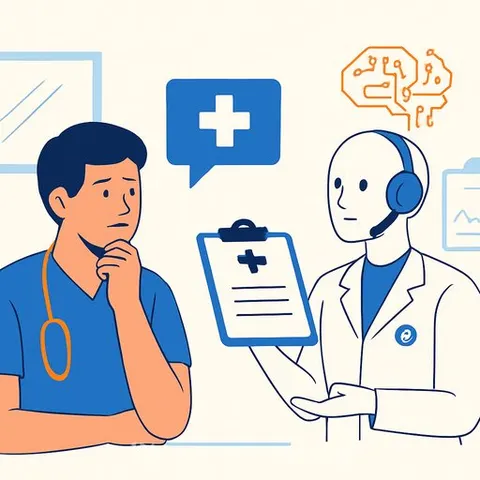
Medical trainees who rely on AI early may never develop essential clinical skills
A new research perspective published in Nature Medicine identifies a risk in medical education that has escaped serious attention: trainees who use AI heavily during their formative years may fail to build the foundational reasoning skills that safe, independent practice requires.
Researchers call this "never-skilling"-distinct from deskilling, where experienced clinicians lose abilities after relying on automation, or mis-skilling, where trainees absorb errors from AI systems as fact.
The concern rests on established learning theory and early signals from non-medical fields. When high school students used generative AI without guardrails in mathematics, their learning suffered. Cognitive offloading-outsourcing mental effort to a tool-can prevent the struggle that builds competency.
The mechanism is straightforward
Clinical reasoning develops through deliberate practice: working through difficult cases, making mistakes, and correcting them. If AI handles the reasoning early in training, trainees skip this essential phase. They may later struggle to think independently when AI is unavailable, unreliable, or wrong.
The problem compounds because trainees may not recognize their own gaps. Research shows AI systems often lack the self-awareness needed to flag their own errors. A trainee who accepts an AI suggestion without skepticism learns to trust without verification-a dangerous habit in medicine.
No direct evidence yet exists from medical training settings. But the authors point to a real-world signal: a study of endoscopists found performance declined after exposure to AI-assisted colonoscopy, even among experienced practitioners.
A three-phase framework for responsible integration
The researchers propose introducing AI in stages, not all at once.
- Phase one: Build baseline competency without AI. Trainees learn to diagnose, reason, and act independently. This establishes the skills they'll need to evaluate AI output later.
- Phase two: Teach critical calibration. Trainees learn when AI helps, when it fails, and how to verify its reasoning against their own.
- Phase three: Integrate AI under supervision. Once trainees can think independently and critically assess AI, they use it as a tool-not a replacement for judgment.
This approach mirrors aviation safety protocols, where pilots master manual flight before relying on autopilot.
The timing question remains unanswered
Medical schools and training programs currently lack clear guidance on when and how to introduce AI. Two-thirds of physicians now use health AI, according to the American Medical Association. Yet educational frameworks lag behind adoption.
The authors call for empirical research to test whether early AI use actually impairs independent competency. Studies would need to track trainees over years, comparing those with different exposure patterns to AI during training.
Policy decisions should wait for this evidence. Until then, medical educators face a choice: introduce AI broadly and risk never-skilling, or restrict early exposure and risk leaving trainees unprepared for a profession where AI tools are now standard.
The stakes are high. A clinician who cannot think independently is unsafe, regardless of how powerful the AI at their side.
Learn more about AI for Education and responsible implementation in learning environments, or explore the AI Learning Path for Teachers to understand how educators can integrate these tools effectively.