
AI news ·
Missouri plans to use artificial intelligence to administer Medicaid work requirements
Missouri will use AI to verify Medicaid work requirements for 1.26 million enrollees this December. Lawmakers approved nearly $50 million to upgrade software for the mandate.
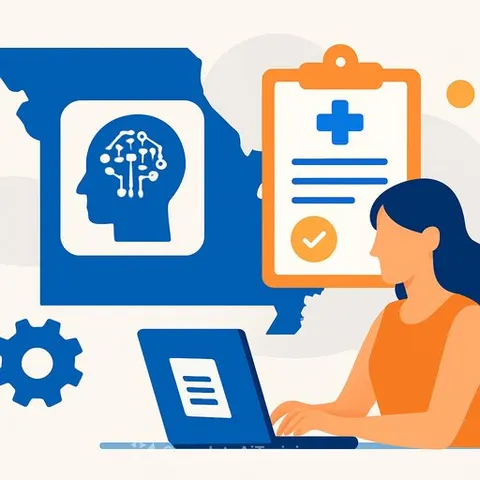
Missouri is one of six states planning to deploy artificial intelligence to manage Medicaid eligibility and work requirements starting this December. The state aims to use the technology to process documents and match data as a new federal mandate requires 1.26 million enrollees to prove 80 hours of monthly work, school, or caregiving.
Under the federal budget bill, Medicaid recipients aged 19 to 64 must verify their monthly hours, with exemptions for parents of young children and those who are disabled. This mandate forces states to overhaul their systems quickly. Missouri lawmakers approved nearly $50 million in state and federal funds to update software and handle the new requirements.
Most of Missouri's working-age MO HealthNet patients already meet these criteria. A recent analysis of 2024 U.S. Census data shows 67 percent are employed, while most others qualify through disability, caregiving, or school enrollment. The Missouri Department of Social Services (DSS) requested $6.2 million to build or contract a new program to manage this data, alongside more than 200 additional full-time workers. "Their workload essentially has been doubled," said Brian Colby, vice president of public policy at the Missouri Budget Project.
How AI will handle the workload
Missouri plans to use AI for client interactions, document processing, data matching, and back-end automation. The state is already improving its chatbot software to answer basic application questions without requiring a phone call to a DSS employee.
DSS emphasized that AI will not make final coverage decisions. "No AI tool or algorithm makes adverse eligibility determinations or coverage termination decisions," DSS spokesperson Baylee Watts said. "The system's role is strictly limited to data aggregation, such as identifying missing documentation or summarizing uploaded files."
If automated data matching confirms work requirements, the system processes the positive confirmation. If status cannot be verified automatically, or if the AI flags ineligibility, a state employee reviews the complete file before any action is taken. This push for electronic verification reflects broader trends in AI for Government, where agencies seek to cross-reference existing databases like SNAP records and income reports to reduce manual paperwork.
Expert concerns over automation risks
Despite safeguards, experts warn that human oversight may not prevent errors. "What the research shows is that the human will eventually also start to rely on the computer, because the computer is right most of the time," said Elizabeth Edwards, a senior attorney at the National Health Law Program. "They will stop looking as carefully at them. ... The idea that a human in the loop is solving the problem of any type of AI monitoring is really not sufficient."
States also face tight timelines to test new software. A recent KFF survey found states worry that vendor AI solutions cannot accurately verify eligibility for gig workers, medically frail enrollees, or homeless individuals. Missouri already partners with SteadyIQ, an AI-powered program that lets enrollees link bank accounts and gig work platforms to verify income.
The state is finalizing contracts with new vendors to integrate with existing eligibility systems. Tracking work requirements has historically caused coverage losses. In Arkansas, over 18,000 adults lost Medicaid during a brief work requirement period, disproportionately affecting those without home internet access. Missouri currently ranks 30th nationwide for broadband access.
Why this matters for government, healthcare, and IT professionals
This rollout highlights the tension between rapid policy mandates and the reality of legacy IT infrastructure. For AI for Healthcare administrators and state IT teams, the challenge lies in building, testing, and monitoring data-matching tools under strict deadlines. As Edwards noted, improving data matching could significantly decrease workloads, but only if the systems are rigorously tested to prevent costly coverage errors.