
AI news ·
MIT forum examines AI's impact on work and democracy
MIT audited 12 large language models during the 2024 election and found responses shifted sharply by demographics and political leanings. They warned of potential democratic chaos.
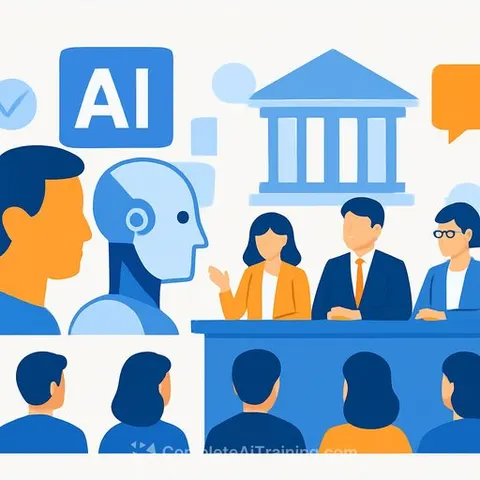
At MIT's AI and Society Forum on May 12, economists, computer scientists, and political researchers confronted the ways artificial intelligence is altering labor and democracy. Organized by the School of Humanities, Arts, and Social Sciences (SHASS) and the Social and Ethical Responsibilities of Computing (SERC), the event brought together scholars to map both productivity gains and the risk of institutional disruption.
AI and the value of human expertise
Economist David Autor opened the forum by challenging the narrative that AI will simply eliminate jobs. He argued that technology's labor impact hinges on how it affects the scarcity of human expertise. "When I think about how technology interacts with the value of labor, I think about it in terms of how it changes the scarcity of expertise, whether it makes it more valuable or whether it makes it more of a commodity," Autor said. If AI removes routine supporting tasks but leaves expert judgment intact, it could create new specialized work rather than erasing it.
A panel moderated by McKinsey's Rob Loughlin explored the same thread. Daniela Rus, director of CSAIL, described a workplace where robots act as high-level assistants, but she insisted that "the role of the human as the decider, as the person with good judgment, as the person deciding the next step, whatever that is, remains super important." David Mindell, a historian of engineering, emphasized that the nature of work has always shifted. "We need to be supporting individuals, the economy, professions, to constantly be creating the new work," he said. Mindell pointed to cargo flights that still require six pilots because safety systems have evolved slowly, illustrating the gap between automation capability and real-world standards.
Sendhil Mullainathan, professor of economics and EECS, cautioned against conflating short-term productivity boosts with long-term growth. He predicted a period of high variance in how organizations restructure around AI. "If you said, 'exactly how will organizations restructure?' I don't know. But is there going to be a lot of restructuring? It's hard to believe there isn't going to be a lot of restructuring," Mullainathan said.
Democracy, elections, and AI bias
Chara Podimata, an operations research professor, presented a longitudinal audit of 12 large language models during the 2024 U.S. presidential election season. Her team found that chatbot responses shifted sharply based on stated demographics and political leanings. "Algorithms decide a lot of things about our lives right now," Podimata said. She is now preparing a revised audit for the 2026 midterm elections with input from political scientists.
A panel on democracy raised deeper concerns. Bailey Flanigan, a political science professor, warned that automating consensus-building risks stripping away the procedural rituals that give democratic decisions legitimacy. Charles Stewart III, founding director of the MIT Election Data and Science Lab, said his biggest fear is chaos after an election. "If and when things go wrong, they can go really bad, and really wrong. If an election is called into question, that can lead to violence," Stewart said. He added that even low-tech eras have seen election manipulation, and AI could create "irreversible disruptions."
Lily Tsai, director of the MIT Governance Lab, argued that AI often runs counter to democratic norms. She cited the need for designers to embed principles like agency, political equality, and mutual respect. Yet she also described a "Socratic dialogue chatbot" her team built that asks people to explain the reasoning behind their beliefs. "And that actually, interestingly, seems to moderate their policy position in the process," Tsai said. Her work shows how AI could strengthen democratic deliberation when designed with clear ethical commitments.
For policy makers and researchers working at this intersection, the forum's discussions connect directly to practical training. The AI Learning Path for Policy Makers covers governance frameworks and bias auditing similar to those explored in Podimata's election audits. Similarly, the AI for Government course collection addresses the institutional challenges panelists raised about workforce restructuring and public sector adoption.
Why this matters for government and science professionals
The MIT forum made clear that AI will not simply erase jobs or fix elections-it will demand new forms of oversight, deliberate policy design, and a deeper understanding of where human judgment remains irreplaceable. Government and research professionals must now build expertise in auditing algorithmic bias, shaping workforce transition policies, and protecting democratic processes from disruption. The shift is not about whether AI will restructure institutions, but how quickly professionals can equip themselves to guide that restructuring toward outcomes that preserve both productivity and public trust.