
AI news ·
Nvidia buys Hugging Face for $12.93 billion in push into open-source AI
Nvidia will acquire developer platform Hugging Face for $12.93 billion, deploying part of its $22 billion cash reserve to control a hub for open-source AI models.
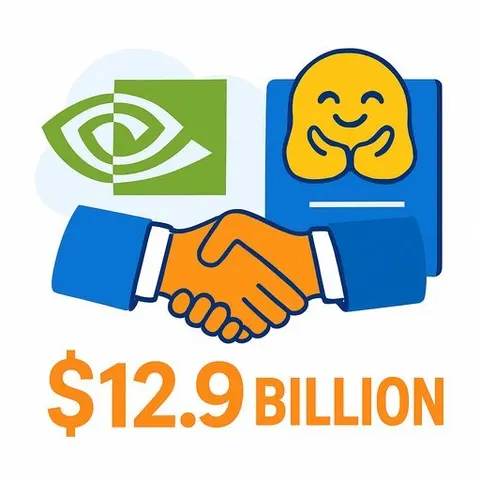
Nvidia will acquire developer platform Hugging Face for $12.93 billion, the companies said Thursday, deploying a chunk of its $22 billion cash pile to secure a central hub for the open-source AI models that are eroding the pricing power of closed systems from OpenAI and Anthropic.
The deal gives Nvidia direct access to the millions of developers who use Hugging Face to find, test, and deploy models. It also arrives as Nvidia's largest customers - Meta, OpenAI, and Microsoft - are designing their own AI chips to reduce dependence on the company's processors. Nvidia will pay roughly $11.9 billion to Hugging Face investors and set aside up to $1 billion in equity-based retention awards for employees who join the chipmaker.
An open platform, with strings attached
Nvidia CEO Jensen Huang moved immediately to reassure developers that ownership would not lock them into Nvidia hardware. "Hugging Face will remain an open platform for the entire AI ecosystem," he said. Huang added that developers could choose their preferred models, chips, and cloud platforms.
That pledge met skepticism from some industry observers. "While they have stated otherwise, it is likely that, at a minimum, technical methods will get instrumented to provide a competitive advantage," said Harold Byun, CEO of BlueRock, a startup that helps companies run AI systems safely. "That's something any rational company would seek to do."
The open model movement has gained momentum as businesses push back against the high cost of deploying proprietary AI. Chinese firms such as DeepSeek and Z.ai have emerged as key players, and demand for freely downloadable, customizable models continues to climb. Hugging Face, founded in 2016 by French entrepreneurs Clément Delangue, Julien Chaumond, and Thomas Wolf, hosts models alongside datasets, software libraries, and cloud services for building AI applications. It was last valued at $4.5 billion in an August 2023 funding round that drew investments from Salesforce, AMD, and Amazon.
Strategic influence beyond silicon
The acquisition is one of Nvidia's largest and signals that the company's ambitions reach well beyond selling chips. "Nvidia is clearly buying strategic influence as much as current earnings," said Axel Rudolph, chief technical analyst at IG Group.
Nvidia's growing investment activity - sometimes directed at its own customers - has raised concerns that the $5.4 trillion company may be inflating valuations and fueling an industry bubble. Yet the Hugging Face deal also provides a hedge: if major cloud providers succeed in building their own silicon, Nvidia still owns the platform where a large share of developers source their Generative AI and LLM models. The two companies already collaborate on helping developers use Nvidia's computing services through the platform.
Why this matters for finance professionals
The deal concentrates power over the open-source AI supply chain in a single company whose market capitalization exceeds $5 trillion. For investors, that raises direct questions about whether Nvidia's acquisition strategy is generating real returns or masking demand risk as its largest customers develop alternatives. Analysts tracking the AI sector should watch for changes in Hugging Face's neutrality - any tilt toward Nvidia hardware would shift the economics for startups and enterprises building on open models, potentially redirecting billions in cloud and chip spending.