
AI news ·
Only 29% of global consumers trust companies to use AI responsibly
Only 29% of global consumers trust companies to use AI responsibly. Treating AI as a strategic shift with clear communication and guardrails prevents shadow use and builds trust.
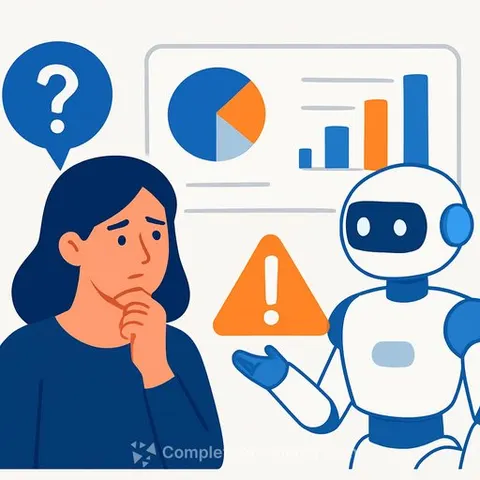
Only 29% of global consumers trust companies to use AI responsibly - a sharp fall from the incremental gains recorded in 2023 and 2024. Employee sentiment is flashing similar warnings as mass AI deployments speed up. Dr Benjamin Granger, chief workplace psychologist at Qualtrics, says the core failure is not technical, but human: organisations are ignoring the trust gap at the heart of adoption.
"From all the data that I'm looking at, I think one of the answers is that this is a trust problem," Granger said. "People are not seeing the 'what's in it for me' in this tool. And that is a key driver of whether people are going to trust it."
Treating AI as a strategic transformation
Most companies that stumble do so because they treat AI as a software rollout rather than a company-wide change exercise, Granger argues. Qualtrics compared successful and unsuccessful AI implementations and found a consistent divide. Organisations achieving real productivity gains approached deployment with the same discipline they would apply to a major restructuring - frequent communication, clearly explained reasoning, and built-in channels for worker feedback. Those struggling simply dropped tools in with minimal guidance.
"A lot of companies are treating AI like a new tool that's being introduced into the workplace, whereas they really should be thinking about it as a strategic transformation," Granger said. "All the things that go along with a strategic transformation - a lot of communication, a lot of conversation, asking people questions about what you find helpful and what you're not finding helpful."
For HR professionals, prioritising communication over technical specs mirrors the guidance found in AI for Human Resources programmes, where trust and user adoption are central themes.
The counterintuitive power of guardrails
One of Granger's more surprising findings is that handing employees open-ended access to a broad set of AI tools does not spark creativity - it paralyses it. He cited an analogy about children playing on a walled island versus an open cliff: when the boundary is clear, creativity flourishes. Without guardrails, the perceived risk is too high and experimentation halts.
"It's precisely when you put the rules and the boundaries around it that the creativity comes out," Granger said. "Some companies are dropping tools in with very little guidance and guardrails and saying, 'go experiment.' Those are not the conditions with which humans are going to be experimental, because the risks could be so high and there's so much uncertainty."
Qualtrics' 2026 workforce data shows the cost of getting this wrong. Employees under heavy pressure were far more likely to use unauthorised AI tools outside company-approved systems - what Granger calls "shadow AI usage." The more anxious the workforce and the fuzzier the guidance, the more individuals will find their own workarounds.
Leading with grounded optimism
Granger advises leaders to acknowledge the genuine disruption AI brings - including fears about job security - without deflating their teams. The method, which he calls grounded optimism, starts by validating what employees are experiencing before pivoting to opportunity. "We hear you, we know that this is tough, but here's what we're doing to support you" is far more effective than leading with the business case.
"That sort of message is going to resonate with employees much more than, 'hey, we had to do this because it's the right thing for the company, end of discussion,'" Granger said. The approach directly addresses the self-protection mode that people default to during upheaval, he added, opening the door to real buy-in.
For senior HR leaders, this shift mirrors the focus of an AI Learning Path for CHROs, which emphasises strategic partnership over siloed function.
Why this matters for HR professionals
Granger's research points to a clear pattern: the organisations seeing returns from AI are not the ones with the most sophisticated tools. They are the ones that treat the human question - trust, communication, psychological safety - as inseparable from the technical rollout. This gives HR leaders a concrete framework: communication first, technology second. As Granger put it, "Companies are made up of people who are trying to work together to meet the needs of other people. That has always been true, it's true today, and it's probably always going to be true." For HR, that means the mandate is no longer to administer a series of tools, but to lead a function that builds the conditions for trust at scale.