
AI news ·
Putin signs Russian law regulating large AI models
Russia signed a 13-article law for AI models with 1 billion parameters. Most rules start September 1, 2026, dropping mandatory content labeling to support sovereign models.
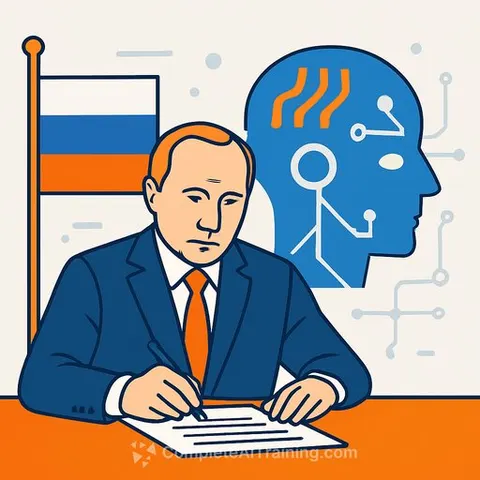
President Vladimir Putin signed a federal law on June 2026 that establishes a legal framework for developing, deploying, and using large foundational AI models in Russia. The legislation targets improved efficiency across state and municipal governance-including healthcare-and aims to build globally competitive AI systems to secure technological leadership.
The law contains 13 articles. It defines general legal principles, spells out the powers of the government and federal authorities, sets mandates for state corporations, and offers support measures for sovereign AI model developers alongside their obligations. It also covers intellectual property use in model training, establishes liability for violations, and outlines rules for international cooperation.
Most provisions take effect on September 1, 2026. A handful of articles will enter into force on March 1, 2027. The government submitted the bill to the State Duma in June 2026.
From broad regulation to focused support
The draft underwent substantial rewrites. In March, the Digital Ministry proposed sweeping rules for all AI technologies, including a "trusted" category for models used in state information systems and critical infrastructure like healthcare. By June, a government commission had reshaped the document. The scope narrowed to supporting large foundational models-those with at least 1 billion parameters. The number of articles dropped from 21 to 13, and the title changed to "On supporting the development of AI technologies."
Several contested provisions were removed entirely. The draft no longer requires mandatory labeling of AI-generated content, no longer demands exclusive use of Russian data and developers, and dropped the concept of "cross-border technologies." Business groups had argued these requirements would drive up costs and delay product launches. The "trusted" category was replaced with "sovereign" and "national" tiers, each allowing different levels of foreign components. Regulation of AI in specific sectors, including healthcare, was deferred.
Copyright and intellectual property
The final text relaxed earlier copyright provisions. Using lawfully obtained works to train models is not considered a violation, as long as the works are accessible without technical restrictions. This gives developers clearer boundaries when assembling training datasets.
Support for sovereign models
The law creates a support framework for developers working on sovereign AI models. It details government and federal authority powers, state corporation mandates, and obligations for developers who receive assistance. The broader goal is to embed AI into AI for Government processes, from administrative workflows to healthcare delivery, without imposing blanket rules on all sectors at once.
Why this matters for government professionals
For policy officers, procurement specialists, and agency heads, this law signals that by 2026, foundational AI models will become part of the state governance toolkit. The phased rollout and the shift from "trusted" to "sovereign" tiers mean you will need to distinguish between models that meet national criteria and those that do not-decisions that will shape vendor selection and compliance checks. Those responsible for digital transformation should track the deferred sector-specific rules closely, as they will dictate how AI enters healthcare and other public services. Building internal expertise now, through resources like the AI Learning Path for Policy Makers, can prepare teams to evaluate model parameters, data provenance, and liability frameworks before the law takes full effect.