
AI news ·
Sanders and Fain warn AI could destroy millions of jobs like NAFTA did
Sen. Bernie Sanders, UAW President Shawn Fain, and AFL-CIO leaders warned Thursday that AI could eliminate millions of jobs across manufacturing, law, and engineering. They called on lawmakers to act before displacement outpaces any policy response.
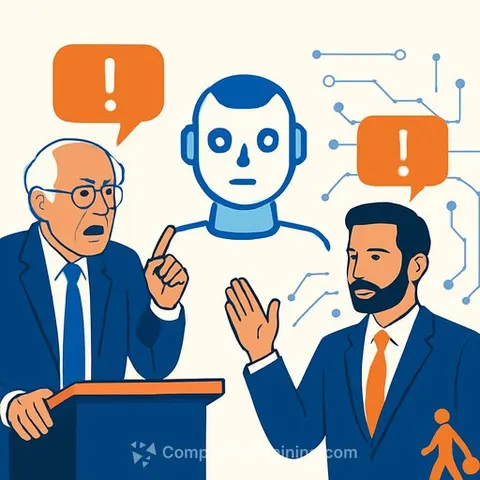
Sanders and Labor Leaders Warn AI Could Eliminate Millions of Jobs
U.S. Sen. Bernie Sanders joined UAW President Shawn Fain and other labor leaders Thursday to warn that artificial intelligence poses a significant risk to American workers-a concern they say policymakers are largely ignoring.
"We are looking at the most consequential and significant technological revolution in the history of humanity," Sanders, I-Vt., said during a Capitol Hill press conference. "It doesn't take a rocket scientist to figure out that, maybe, human beings and workers should benefit from this transition, rather than a handful of multi-billionaires."
Which Jobs Are at Risk
Sanders suggested AI could eliminate positions across multiple sectors. Blue-collar jobs in transportation and manufacturing face threats, as do white-collar roles in engineering, accounting, and law.
Fain drew a direct parallel to the North American Free Trade Agreement, which labor advocates have long blamed for destroying manufacturing jobs in the industrial Midwest. "We've lived through the experience of millions of people, millions of jobs being destroyed on false promises of shared prosperity," Fain said. "It was called NAFTA."
He continued: "The American working class was sold a bill of goods back then. We were told NAFTA would create millions of jobs and would lift the standard of people everywhere. We were also told we'd get retrained if that wasn't the case. Instead, we got millions of jobs and thousands of communities destroyed."
What Labor Leaders Are Demanding
Fain cited the UAW constitution, which states that workers should never become "an adjunct to the tool, rather than its master." He warned that uncontrolled AI deployment could strip workers of their dignity and finish the job of eliminating remaining manufacturing employment.
AFL-CIO President Liz Shuler called for two immediate actions: workers must fight for AI and automation protections in union contracts, and lawmakers must develop safeguards against rapid economic disruption.
"What we do right now is going to shape the next 20, 50, 100 years for working people," Shuler said.
Current Policy Efforts
Sanders and U.S. Rep. Alexandria Ocasio-Cortez introduced a bill last month to slow the national buildout of AI data centers while the country addresses economic, security, and environmental concerns.
Meanwhile, private sector AI integration continues. Stellantis NV and Microsoft announced a five-year partnership Thursday to develop AI initiatives.
American Federation of Teachers President Randi Weingarten framed the stakes broadly: "This is the most fundamental change that has happened in society, certainly in my lifetime, and maybe in all of history. And when you have this kind of fundamental change, you would think that the greatest country of the world would stop and say, 'What do we do about this?' and not just let five or 10 gazillionaires have carte blanche to do whatever they want."
What This Means for HR Professionals
HR leaders face mounting pressure to address workforce displacement risks. Understanding AI's impact on talent management and workforce planning is no longer optional. AI for Human Resources resources can help professionals understand how the technology affects recruitment, retention, and organizational strategy.
For HR executives, AI Learning Path for CHROs offers executive-level training on workforce analytics and talent strategy-skills needed to navigate both the opportunities and risks these labor leaders are raising.