
AI news ·
Tech companies increase AI spending and layoffs even as human labor remains cheaper
Tech companies have cut over 118,000 jobs this year. AI automation is currently economically viable in only 23% of vision-based roles.
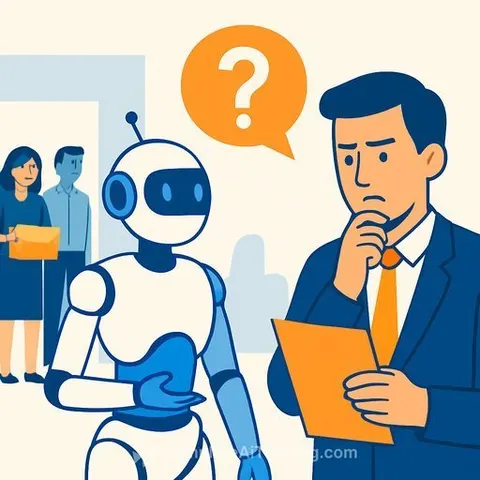
Tech companies are laying off thousands of workers while simultaneously increasing artificial intelligence spending, creating a mismatch between labor costs and technology investments. Despite heavy capital expenditures, current AI deployment often costs more than the human workers it is meant to replace, raising questions about the economic viability of widespread automation.
The true cost of AI deployment
Meta plans to lay off 10% of its workforce, roughly 8,000 employees, and scrap hiring for 6,000 open positions to run the company more efficiently. Microsoft has also offered thousands of employees a voluntary buyout. However, these workforce reductions do not mean AI is currently saving money on labor.
Bryan Catanzaro, vice president of applied deep learning at Nvidia, told Axios in April that for his team, the cost of compute is far beyond the costs of the employees. An MIT study from 2024 supports this, finding that AI automation is economically viable in only 23% of roles where vision is a primary part of the work. In the remaining 77% of cases, human labor remains cheaper.
Furthermore, AI tools have proven fallible. In one instance, an engineer reported that an AI agent destroyed his database and network due to overuse.
Surging budgets and workforce reductions
Big Tech firms have announced $740 billion in capital expenditures this year so far, a 69% increase from 2025, according to Morgan Stanley. This spending surge is forcing companies to rethink their budgets quickly.
Uber chief technology officer Praveen Neppalli Naga told The Information that the company burned through its entire 2026 AI coding tools budget by April after incentivizing employee adoption. Similarly, Microsoft is canceling most of its direct Claude Code licenses, pivoting to GitHub Copilot CLI after the technology became too popular too fast.
This spending increase coincides with accelerated workforce reductions. Data from Layoffs.fyi shows more than 118,000 tech layoffs in 2026 so far across nearly 100 companies, already outpacing the roughly 120,000 total layoffs from the previous year.
Keith Lee, an AI and finance professor at the Swiss Institute of Artificial Intelligence's Gordon School of Business, said this exposes a meaningful discrepancy in the economics of AI. "What we're seeing is a short-term mismatch," Lee said.
When AI will reach cost balance
AI operating costs remain high due to hardware and energy requirements. McKinsey data projects AI expenditures may reach $5.2 trillion by 2030, with $1.6 trillion from data center spending and $3.3 trillion from IT equipment. Meanwhile, fees for AI software have increased by 20% to 37% over the past year, according to spending management firm Tropic.
Flat subscription models are also causing AI companies to lose money on heavy users. As a result, some firms are beginning to reevaluate AI not as a clear cost-saving substitute for labor, but as a complementary tool until the cost structure stabilizes.
A tipping point will arrive when inference costs drop. Gartner predicts the cost of performing inference for a large language model with 1 trillion parameters will plummet by more than 90% over the next four years. Companies will likely shift from flat subscriptions to usage-based pricing.
Federal Reserve data shows about 18% of companies had adopted AI tools as of the end of 2025. For these tools to become economically viable, they must prove reliable with fewer hallucinations and less need for human oversight. "It's not just about AI becoming cheaper than humans," Lee said. "It's about becoming both cheaper and more predictable at scale."
Why this matters for human resources professionals
HR leaders must prepare for a prolonged period where AI serves as a complementary tool rather than a direct replacement for human staff. Workforce planning should account for the rising costs of AI software subscriptions and the need for human oversight to prevent costly technical errors.
Teams evaluating these shifts can benefit from resources on AI for Human Resources to build realistic budgets that balance technology investments with talent retention. As companies reevaluate their automation strategies, HR professionals can guide leadership toward sustainable workforce models.
Developing internal expertise is critical during this transition. HR managers can explore the AI Learning Path for HR Managers to better understand workforce analytics and talent management as organizations adjust to new technological realities.