AI agent for service managers
Team Process Bottleneck Agent
The real bottleneck identified with evidence.
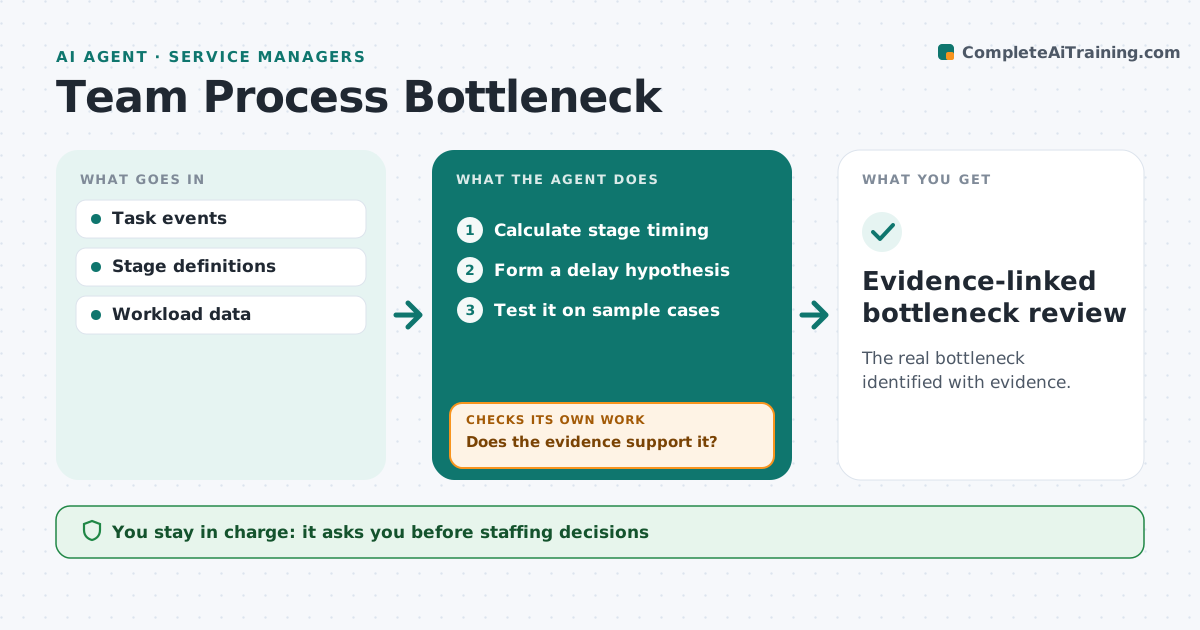
What it does
Repeated delays often get blamed on the wrong step or the wrong team. When a manager asks why work is slow, this agent calculates time spent in each stage from the workflow records and separates waiting time from active work. It forms a hypothesis about the bottleneck and tests it against specific sample cases. If the evidence does not support it, for example delays track missing inputs rather than staffing, it revises the hypothesis and tests again. It writes an evidence-linked bottleneck review. Staffing decisions and ratings stay with the manager. Edge case: approvals look slow, but most of the time is spent waiting for missing documents.
How it works
Follow the arrows from top to bottom. The orange dashed arrow is the loop: when a check fails, the agent goes back and tries again.
Read the steps as a list
- Delay question
- Calculate stage timing
- Form a delay hypothesis
- Test it on sample cases
- Does the evidence support it?If not: revise the hypothesis. Back to step 3.
- Write the bottleneck review
- Evidence-linked bottleneck review
How it decides
It tests the leading hypothesis on sample cases and revises when evidence disagrees.
- Separate waiting time from work time.
- Test inputs before staffing as a cause.
- A hypothesis holds only if most sample cases support it.
Make it yours
Every agent is a starting point. You choose these settings for your own situation.
- Workflow record sources
- Number of sample cases (default 30)
- Time window analyzed (default last 90 days)
- Report format
What keeps you in control
It always asks you first
- Staffing decisions
- Performance ratings
Hard limits
- No blame.
It stops when
- Done: bottleneck found.
Set it up
We guide you through the set-up, step by step
Members get the full set-up guide for this agent. No technical skills needed: you copy, paste and upload.
- One set of instructions to paste into your AI, with the clicks for ChatGPT, Claude, Microsoft 365 Copilot, Gemini and Grok
- The agent then walks you through connecting your own data, one source at a time
- A downloadable copy with the flow chart, the rules and the full guide