MCP server · Security · official
Agent Passport MCP server
by aeoess · official
Give your AI a signed identity, limited permissions, and a paper trail for every action it takes.
This is a helper that gives your AI assistant an identity card and a set of rules. It is made by the company behind the Agent Passport System, and it is aimed at people who need to keep track of what an AI is allowed to do and prove later what it actually did. If you just want your AI to write emails, you do not need this. If you are handing an AI real tasks with real limits, this is for you.
What is an MCP server? The 30-second version
On its own, your AI can only chat. An MCP server is a small helper program that gives your AI a new skill or a connection to a service. This one connects your AI to the Agent Passport System, a service that hands out digital identity cards and permission slips for AI agents. Once connected, your AI can ask that service to create an identity, check someone else's identity, or record what it did, and the service answers back.
What this MCP server does
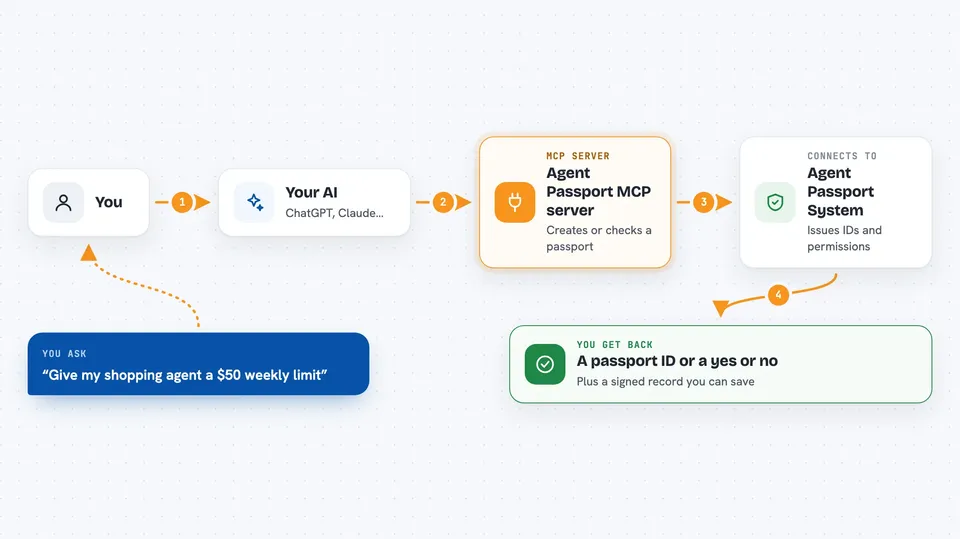
You ask your AI to do something that involves identity or permissions. Your AI calls this helper, and the helper talks to the Agent Passport System. The system creates keys, issues a passport, checks a signature, or writes a signed record of the action. The result comes back to your AI, and your AI tells you what happened in plain words.
 Click to zoom
What you can do with it
- Create a digital identity (a passport) for an AI agent
- Verify that another agent's passport is real and not expired
- Hand out limited permissions to another agent, with spending caps and time limits
- Take back permissions you gave earlier
- Record what an agent did in a signed, checkable way
- Ask a human to approve a purchase before it happens
- Track how much an agent has spent against its limit
Try asking your AI
- “Create a passport for my research agent and show me its public key”
- “Give my shopping agent permission to spend up to 50 dollars this week, nothing more”
- “Check whether this passport from another agent is valid and who issued it”
- “Show me a signed record of everything my agent did today”
What it gives back to you
You get back answers in the chat: a passport ID, a public key, a yes or no on whether something verified, a spending summary with numbers, or a signed record you can save. Some actions create files or receipts you can check later. Everything is written in plain text your AI can read out to you.
Before you start
What you need
- The Claude desktop app, Claude Code, Cursor, or another AI app that supports MCP servers
- Node.js installed on your computer if you run it locally (the setup command handles most of this)
- Nothing extra if you use the remote option, which connects over the internet
Good to know
This server can create identities, hand out permissions, and write records that others may treat as proof, so check what you are approving before you say yes.
Install it with your AI
Add Agent Passport MCP server to your AI, no technical skills needed
You don't install anything by hand. You copy one prompt, paste it into an AI that can work on your computer, and it checks, installs and connects the server for you, asking you when it needs something.
Sign in to get the install prompt
Members get a ready-made prompt that lets the Claude desktop app check Agent Passport MCP server, install it and connect it for them, step by step. You don't need any technical skills: you copy, paste and answer a few questions. Your connected AI can also find and install any of the 4,361 MCP servers here for you.
Who it's for
People who run AI agents that spend money, touch private data, or act on someone's behalf, and who need a clear record of who allowed what.