MCP server · Developer tools
Postman MCP server
by delano
Lets your AI look at and manage your Postman collections, environments, and APIs for you.
This is a small helper that connects your AI assistant to Postman, the tool many teams use to test and organize their web requests. Once it is set up, you can ask your AI to list, create, or update things in your Postman account instead of clicking through the app yourself. It is handy for developers and testers who live in Postman all day.
What is an MCP server? The 30-second version
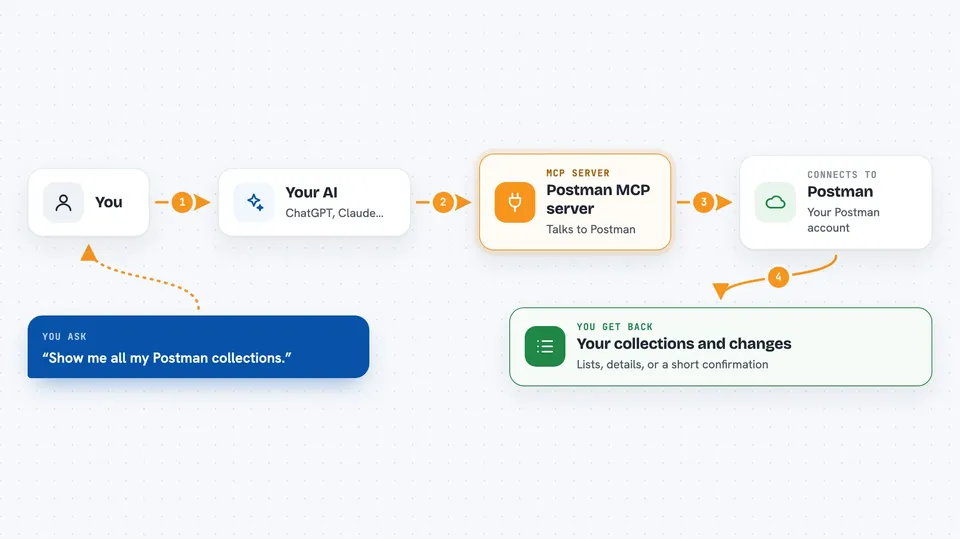
On its own, your AI can only chat with you. An MCP server is a small helper program that gives your AI one new skill, in this case a connection to Postman. When you ask something like "what collections do I have?", your AI passes the question to this helper, the helper asks Postman, and the answer comes back into your chat. You never touch the helper directly; you just talk to your AI like normal.
What this MCP server does
You type a request in plain words, like asking for your list of collections. Your AI sends that request to this helper program, which is running quietly in the background. The helper then talks to the Postman service using your Postman API key, which is like a password that proves it is you. Postman sends back the information, and the helper hands it to your AI, which shows it to you in the chat. If you ask it to change something, like adding a request to a collection, the helper makes that change in your Postman account.
 Click to zoom
What you can do with it
- List your Postman collections, environments, and APIs
- Create a new collection or environment
- Add, update, or delete requests inside a collection
- Organize requests into folders
- Fork, merge, or pull changes for a collection
- Add comments to collections and APIs
- Create webhooks that trigger collections
Try asking your AI
- “Show me all my Postman collections.”
- “Create a new environment called Staging with a base URL variable.”
- “Add a GET request for /users to my API Testing collection.”
- “List the APIs in my workspace and their tags.”
What it gives back to you
You get answers right in the chat: lists of collections, environments, or APIs, details about a specific request, or a short confirmation that something was created, updated, or deleted. For example, if you ask for your collections, you will see their names and IDs listed out. If you ask it to add a request, it will tell you it was added and where.
Before you start
What you need
- A Postman account
- A Postman API key (a kind of password for apps; you generate one for free in your Postman account settings)
- Node.js installed on your computer
- The Claude desktop app or another AI tool that supports MCP servers
Good to know
This helper can create, change, and delete things in your Postman account, so double check before you ask it to remove anything.
Install it with your AI
Add Postman MCP server to your AI, no technical skills needed
You don't install anything by hand. You copy one prompt, paste it into an AI that can work on your computer, and it checks, installs and connects the server for you, asking you when it needs something.
Sign in to get the install prompt
Members get a ready-made prompt that lets the Claude desktop app check Postman MCP server, install it and connect it for them, step by step. You don't need any technical skills: you copy, paste and answer a few questions. Your connected AI can also find and install any of the 4,609 MCP servers here for you.
Who it's for
Developers, testers, and anyone who manages Postman collections and APIs and wants to do it by chatting instead of clicking.