MCP server · Developer tools
Azure MCP server
by dockndevai
Lets your AI look at and manage your Azure cloud resources, with safety limits so it cannot do damage.
This is a helper that connects your AI assistant to Microsoft Azure, the place where many companies keep their cloud servers, storage and other services. Once it is set up, you can ask your AI in plain English what is running in your Azure account, or ask it to start and stop virtual machines. It is handy for anyone who works with Azure but does not want to click around the Azure Portal all day.
What is an MCP server? The 30-second version
On its own, your AI can only chat. An MCP server is a small helper program that gives your AI a new skill or a connection to an app. This one connects your AI to Azure, so it can look things up there and, if you allow it, make changes for you. You just ask in normal words, and the helper does the talking to Azure behind the scenes.
What this MCP server does
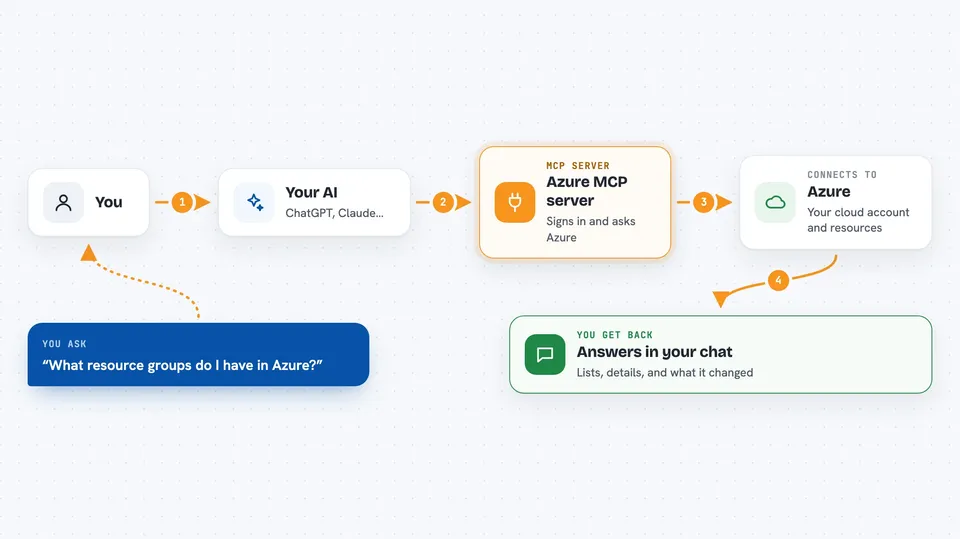
You ask your AI something like "what resource groups do I have?" The AI passes that question to this helper. The helper signs in to Azure using a set of credentials you gave it, asks Azure for the answer, and hands it back to your AI. Your AI then shows you the list in the chat. For changes like starting a virtual machine, the same path happens, but the helper checks your safety settings first before doing anything.
 Click to zoom
What you can do with it
- List your Azure subscriptions and the regions available
- List resource groups and what is inside them
- Look up details of any single Azure resource
- Add or update tags on a resource, like env=prod
- Start, stop, restart or deallocate a virtual machine
- Create a new resource group in an approved region
- Delete a resource group or resource, only if you have turned that on
Try asking your AI
- “List all resource groups in my subscription and which region each is in”
- “Show every resource in the rg-web group”
- “Tag the app-plan resource with env=prod and owner=team-a”
- “Stop the build-agent VM in rg-ci”
What it gives back to you
You get answers in the chat: lists of subscriptions, regions, resource groups or resources, with their names and details. For changes, it tells you what it did, like which VM it stopped or which tag it added. If something is blocked by your safety settings, it says so instead of doing it. When dry-run is on, it shows what it would have done without actually doing it.
Before you start
What you need
- An Azure account with at least one subscription
- An Entra ID service principal (a kind of app login for Azure) with a tenant ID, client ID and client secret
- Node.js installed on your computer so npx can run the helper
- An MCP-capable AI app like Claude Desktop, Claude Code, Cursor or Codex
Good to know
It can change and delete real Azure resources, so keep it in read-only mode unless you really need more, and turn on the allowlists and confirmation settings.
Install it with your AI
Add Azure MCP server to your AI, no technical skills needed
You don't install anything by hand. You copy one prompt, paste it into an AI that can work on your computer, and it checks, installs and connects the server for you, asking you when it needs something.
Sign in to get the install prompt
Members get a ready-made prompt that lets the Claude desktop app check Azure MCP server, install it and connect it for them, step by step. You don't need any technical skills: you copy, paste and answer a few questions. Your connected AI can also find and install any of the 4,609 MCP servers here for you.
Who it's for
IT admins, cloud engineers and developers who manage Azure resources and want to ask their AI instead of clicking through the Azure Portal.